
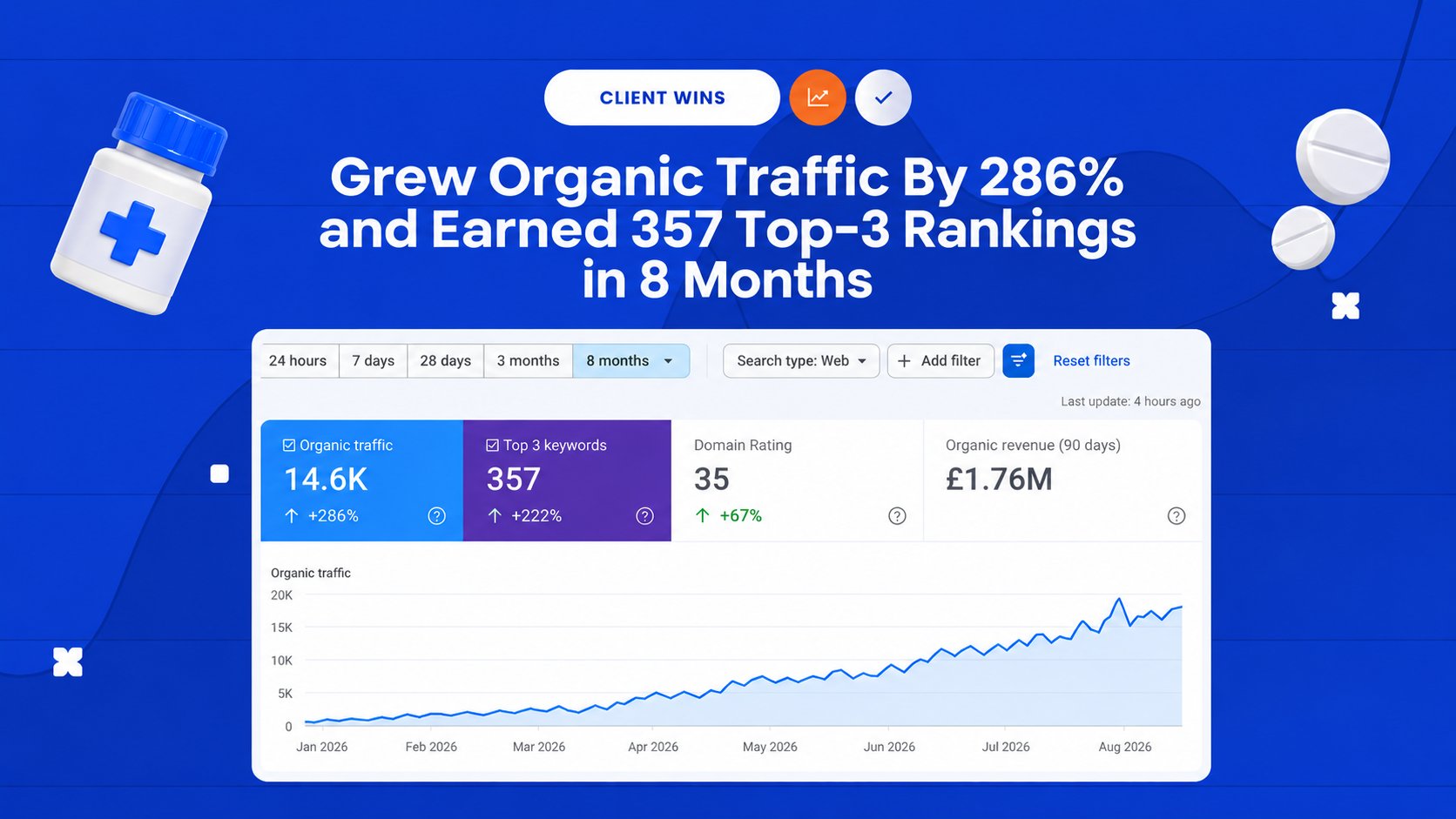
Read how we took this established UK online pharmacy from near-zero organic visibility to 7 top-3 rankings for Mounjaro terms. This is easily one of the most competitive categories in UK search, but with our technical SEO, price-comparison content, and 169 quality-controlled backlinks, we were able to achieve fantastic results.
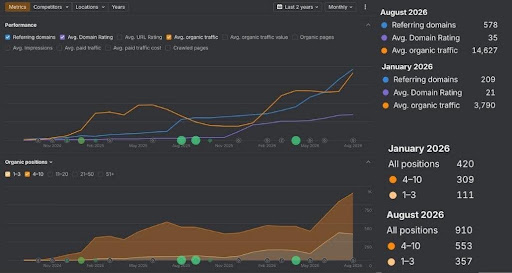
Search data from Ahrefs Site Explorer (UK market, whole domain), pulled on 19 August 2026. Engagement began in January 2026. Traffic value is reported by Ahrefs.
Our client is an established UK online pharmacy that sells over-the-counter and prescription medications, from vitamins and supplements to pain relief. Recently, they’ve moved into prescription weight-loss treatments such as Wegovy and Mounjaro, which is the fastest-growing category in UK consumer health.
“Weight-loss treatments” is one of the hardest categories to rank in for two reasons:
Because these search terms are so big, almost every serious competitor is trying to rank for them. This makes them incredibly difficult and high-risk to rank for at first.
Competitors ranking for these search terms are industry giants. For example, the first page of the search results was dominated by national high-street pharmacy chains and popular, well-funded telehealth platforms.
Several of these competitors also had Domain Ratings above 80, which basically means they possess an exceptionally strong, world-class backlink profile. Compare this directly to our pharmacy client, which only had a Domain Rating of 21 when we started working with them.
However, the DR alone is not something to base authority on. A website can have a high DR, but you need to consider this metric along with other ones to understand where a website is at in terms of authority.
We started working with this client in January 2026. At that point, the business was gaining customers using paid search and very little else. Their organic search strategy only brought in around 3,790 visits a month across the entire website.
When it came to ranking for important Mounjaro keywords, our client sat in positions 60 to 98, which is basically pages six through ten on the search results. The majority of people only look at the first page of the search results, with less than 1% of users actually clicking through to Page 2. Research also suggests that searchers prefer to refine their search query rather than scroll down to the bottom of Page 1 if they don't see what they’re looking for immediately.
So, what did this mean in practical terms? Basically, it meant nobody knew our client was there. They had fantastic products, but their ideal customer base didn’t even have a chance of finding them.
"We've been running Google Ads, but now it's starting to make sense to bring in the SEO side of things. The earlier we start, the better."
— Co-Founder, kick-off call, January 2026
Another complication that came up when we were just getting started was the website itself. The site had been built and maintained by a third-party development agency. This meant that every technical change we recommended needed to be approved by the client and then passed on to a third-party development team.
We see this a lot. Clients who have been burned by agencies before can be hesitant to trust us and push for results-based pricing. We get it, but we declined.
However, we’re always willing to compromise – especially since we know we can get real results for our clients. We proposed a smaller monthly package and offered to prove the model before we scaled it.
This UK pharmacy’s website was structurally unreadable to search engines, which made it much harder for them to rank.
When we work with a new client, we begin with a full technical audit. We found that 161 pages had no crawlable H1 heading. Although when we checked manually, we could see headings on our screen, they couldn’t be read by the crawlers. This meant search engines like Google wouldn’t have been able to see them when scanning the website’s code. The H1 is the strongest on-page relevance signal and, in these cases, it wasn’t doing the job it needed to do on those pages.
When it came to product pages, the heading hierarchy had been implemented to look nice only – not to provide a logical heading structure. Blog module titles were rendering as H2s inside product templates. Even these seemingly small issues would have been seriously impacting the website’s SEO.
For this client it resulted in keyword cannibalization, which is when multiple pages on the website try to rank for the exact same target keyword or search intent. For this brand, their own weight-loss landing page was competing against its own product pages for the same searches, and Google was choosing between them rather than ranking either with confidence.
Search engines use headings to work out what a page is about. When the most important heading is missing, or when you have three pages on your website that claim to be about the same topic, this can confuse search engines. Google has to pick one, and it often trusts neither enough to rank highly, or can’t decide which one to promote and thus, jumps between pages. This impacts your SEO strategy because both pages sit lower than a single clear page would have.
For our client, we found that their website was generating and indexing multiple URLs for the same page.
If one page has several URLs, this means that the ranking signals it earns get divided between them instead of accumulating. Because of this, every backlink and every visit was worth a fraction of what it should have been. The broken and bloated URLs also consumed crawl budget, which meant Google spent its limited time on the site visiting pages that could never generate a sale.
If one thing’s going to destroy your SEO, it’s a bad backlink strategy. Backlinks are links to your website or webpages that come from other websites. A quality backlink is basically a green flag to Google – they see them as votes of confidence. They show that your website and your brand can be trusted.
However, one mistake we see many brands making is treating all backlinks as equal. You need high-quality backlinks from trusted, authoritative websites with a good Domain Rating to really get Google’s attention. Low-quality or spammy backlinks can be seen as red flags and weigh your page or whole site down. There are black-hat SEO link-building tactics that can lead to websites being penalized by Google.
With this client, we found that their website had very few quality links and a high amount of poor backlinks. They’d never submitted a disavow file, so this was handled week one of working together.
With AI producing surface-level, fluff content, Google prioritizes brands that know their stuff – and can prove it. This is because of their E-E-A-T guidelines:
Demonstrating these will show Google that your content is quality.
With this client, we found that their website wouldn’t hold up against Google’s framework. Their weight-loss pages were thin content-wise. There was no supporting content that answered the questions buyers were asking before they purchased a prescription treatment:
Nobody buys a prescription weight-loss injection on impulse; they’ll research it for weeks. This is where our client was falling short. It’s important for our clients to use content to take up real estate in the consumer’s mind, so that when they’re ready to purchase, it’s our client’s brand that comes to mind first.
Furthermore, with such thin content, there was nothing to position this brand as an authority in their space. It was no wonder their competitors were dominating the search results.
Health and pharmacy are classified as “Your Money or Your Life” (YMYL) topics. This basically means that these pages and websites could directly impact a person's health, financial stability, safety, or overall well-being. Because of this, Google evaluates YMYL content under significantly stricter standards than general content. Google is explicitly looking for evidence that a real, accountable, qualified organization stands behind the advice.
When we started working with this client, they weren’t optimized to adhere to these standards. They had no team or credentials page, with no named clinician attached to its medical content, and no product reviews.
We asked early whether a doctor was available to be at the forefront of their content, and the answer was that there was not one at the time. We explained the importance of this, and now they have a pharmacist who is now the vetted source.
The goal was to fix the items suppressing the whole site, and then concentrate on one commercial category until it won: weight loss treatments, with Mounjaro above all. This was a deliberate, carefully thought-out choice. Remember, our client’s website only had a Domain Rating of 21 and was up against some serious competitors. If we’d spread out efforts across the full pharmacy catalog, this would have produced a little bit of movement everywhere but rankings nowhere.
Here’s what we did:
We needed to make our client’s website legible to search engines. In order to do this, we:
We knew that two of these changes would cause a short-term dip in rankings while Google re-crawled the affected pages. This didn’t mean we’d made incorrect changes; it just meant the rankings needed a bit of time to recover. Some brands see changes like this and start to panic, but we flagged the changes and possible dips to the client before the work went live. We explained what to expect and why.
The pages recovered – just like we knew they would.
We didn’t want to compete head-on with established competitors for the hardest term in the category. That’s why we targeted the shoppers who wanted to compare prices before buying. Here’s how we did it:
Our Most Important Editorial Rule: All content should be human-written. Most brands think they need to churn out hundreds of content pieces to rank, but that couldn’t be further from the truth. It’s much better to publish a few high-quality, valuable human-written content pieces as opposed to thin, fluffy, AI-generated ones, especially when it comes to the YMYL category. Our content creation process takes time, but it brings the best results for our clients.
Our client’s website had a Domain Rating of 21, while their competitors had DRs of 80+. Because of this, it was essential that we build authority – and fast. Here’s how we did it:
Here are the metrics we used to track the success of our link building strategy:
Most SEO agencies won’t commit to a minimum quality standard on links. This is because it’s much easier to deliver lots of links than it is to deliver valuable, high-quality links. At DTC SEO Agency, quality is central to everything we do, which is why we vet every single backlink we acquire against our strict metrics.
Furthermore, having high-quality links from trusted and authoritative publications becomes even more important in regulated categories. Agencies that buy low quality links from freelancers or work with Private Blog Networks can do more harm for your SEO strategy than good.
Securing the type of high-quality placements our pharmaceutical client needed was genuinely hard, but this is because editorial pharmacy and weight-loss prospects are scarce. However, we will always put in the work to get the results our client needs. Our skilled linkbuilding team screened between 100 and 1,300 prospects a week, and only a small fraction passed our metrics. We widened the search into relevant, adjacent territories, which included:
Some months meant we had to chase publishers for weeks to get an approved placement live. This is the unglamorous half of link building and digital PR – but it is well worth the effort and patience in the end, when we secure the placements we know our clients deserve.
Hard work pays off. All search data below is accurate and has come from Ahrefs, UK market, whole domain, pulled 19 August 2026.

We saw a huge increase in organic traffic for this client, from 3,790 monthly visits in January 2026 to 14,626 in August 2026. This works out at a 286% increase.
The growth came in three phases:
Traffic was flat between April and July, but the commercial value of that traffic more than doubled. This means that the website was attracting the right traffic – traffic with the highest buyer intent.
Source: Ahrefs. Traffic value is Ahrefs' estimate of what the same traffic would cost to buy through paid search, and Ahrefs reports it in USD.
Although huge surges of traffic look good on paper, that means nothing if a website isn’t attracting the right kind of traffic and it holds a strong value. Because of this, the same 10,500 monthly visits were worth $7,462 in April and $19,650 in June. Also, this doesn’t account for repeat purchases and this client made much more when analyzed from our revenue dashboard.

Top-3 rankings are the ones we aim for; this is where the overwhelming majority of clicks happen.
It’s worth noting that between January and March, top 3 rankings barely moved, from 111 to 120. In this period, we were focusing on technical work, and almost nothing visible was happening. However, from March onwards, the curve steepened sharply. This is what compounding looks like from the inside, and it’s why judging an SEO campaign at month two is a mistake. Great results take time.
In January 2026, the client had 54 Mounjaro-related keywords in the UK. Every single one of them sat in positions 60 to 98, which meant that this cluster generated zero organic traffic.
Source: Ahrefs organic keywords filtered to Mounjaro terms, UK, five snapshots.
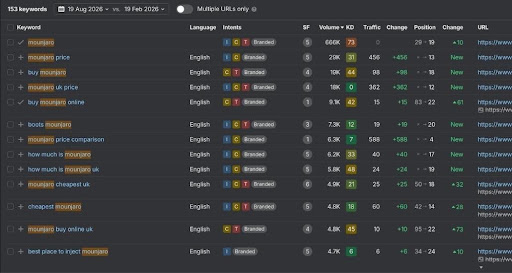
However, things soon turned around:
As shown in the table above, the terms that moved furthest and fastest are the price and comparison terms. The pure transactional head terms, "buy mounjaro" at 19,000 searches a month, moved from position 98 to 18, which is real progress but still short of the first page.
These results helped us hone our strategy even further, which brings us to the single best-performing asset we built.
We were intentional and strategic with our content, choosing to build a comparison page that targeted the type of search a buyer chooses to make just before they purchase: the search that helps them compare treatment costs across UK pharmacies.
The page went live in June 2026. Its first three months gave us the following results:
Source: Ahrefs, page-level metrics history, UK.
Three months after we launched that one page, we saw fantastic results. This page alone:
Domain Rating runs on a compressed relative scale where every increase is more difficult than the last. Competitors are constantly building links, and this means a website has to outpace their growth just to move up on the scale. This makes growing over a DR of 20 incredibly slow. However, for our client, their Domain Rating rose 14 points from January to August: 21 to 35. This is a huge achievement.
We achieved this using high-quality, valuable, and organic link building strategies and digital PR. The referring domains (an external website that contains a link pointing to your site) grew every single month, without a spike (bought links) or reversal (penalties for buying links). This is what earned coverage looks like.
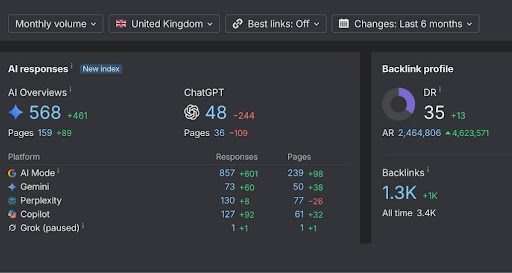
People are no longer searching for information through traditional search engines like Google alone. AI has changed the game. People are also turning to Google's AI Overviews and AI Mode, or ChatGPT, Gemini, Perplexity, and Copilot to answer their health queries. With this client, we optimized our content for AI Search, structuring blog articles and pages so AI systems can discover their pages and pull clean, accurate answers from our client’s content. This is what earns citations in AI search engines.
Across six months from February to August 2026, the brand's presence within AI language models grew sharply:
Source: Ahrefs AI response tracking, UK, February to August 2026.
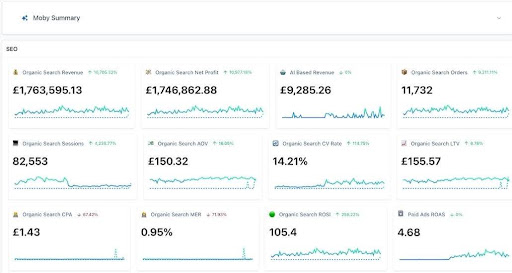
Here’s what the metrics show for SEO investment over the last 90 days (dated from 19th of August):
Important to Note – The client initially had issues installing the TripleWhale dashboard, which is why there isn’t any data from right at the start of the project. However, the rest of the figures speak for themselves: they’ve made £1,763,595 in the last 90 days through Organic Search Revenue and £9,285 in AI Search Revenue.
When you compare the data between SEO and Paid channels over the past 90 days, there are conversion rates 14.21% vs 6.51%. We tend to see higher figures for SEO compared to Paid Ads due to the following factors:
With these factors in mind, it’s easy to see why the cost per acquisition (CPA) for SEO is £1.43 compared to Paid, which is £21.98. SEO investment is much lower in proportion to what it yields, especially compared to Paid Ads channels. However, that’s not to say that Paid isn’t important; Paid ads drum up real estate in the consumer’s mind, and we always see the strongest performance when both Paid Ads and SEO are performing strongly for a brand.
What the Client Had to Say
The most honest measure of how well a campaign is working is whether or not the client is happy.
In early June, with sales down, the client asked us to cut the monthly budget in half. They had not yet seen the TripleWhale dashboard that was installed the month before. We walked them through the attribution data that had started coming in, showing what organic search was actually contributing to the business.
Here’s what they sent back ten days later:
Six weeks after that:

You don’t have to take our word for it. All you have to do is look at the fantastic results we’ve achieved for our client. Here at DTC SEO Agency, we build strategies that get you real, tangible results. We’ll fully manage your SEO, from high-quality, topical content creation to link building and digital PR. We help product-led brands compete in categories they have been told are too competitive to enter and operate with integrity. We’ll tell you what’s needed to achieve your goals and all will be anchored in data.
Here’s where we might be able to help you:
We take care of everything. Book a call with us, and we’ll tell you how we can scale your SEO into something that brings you real results.
Disclaimer: For the purpose of this case study, we have anonymized our client’s name at their request. Results reflect real outcomes for the featured brand. All search data from Ahrefs, UK market, pulled 19 August 2026. Revenue, conversion, and acquisition-cost figures are client-reported through Triple Whale.
Rehan has over 10 years of experience in SEO and digital marketing. He's especially good at Technical SEO and working with developers to implement technical improvements. He loves working with DTC SEO Agency because every client brings a different challenge. Solving those challenges is what keeps the job exciting.