
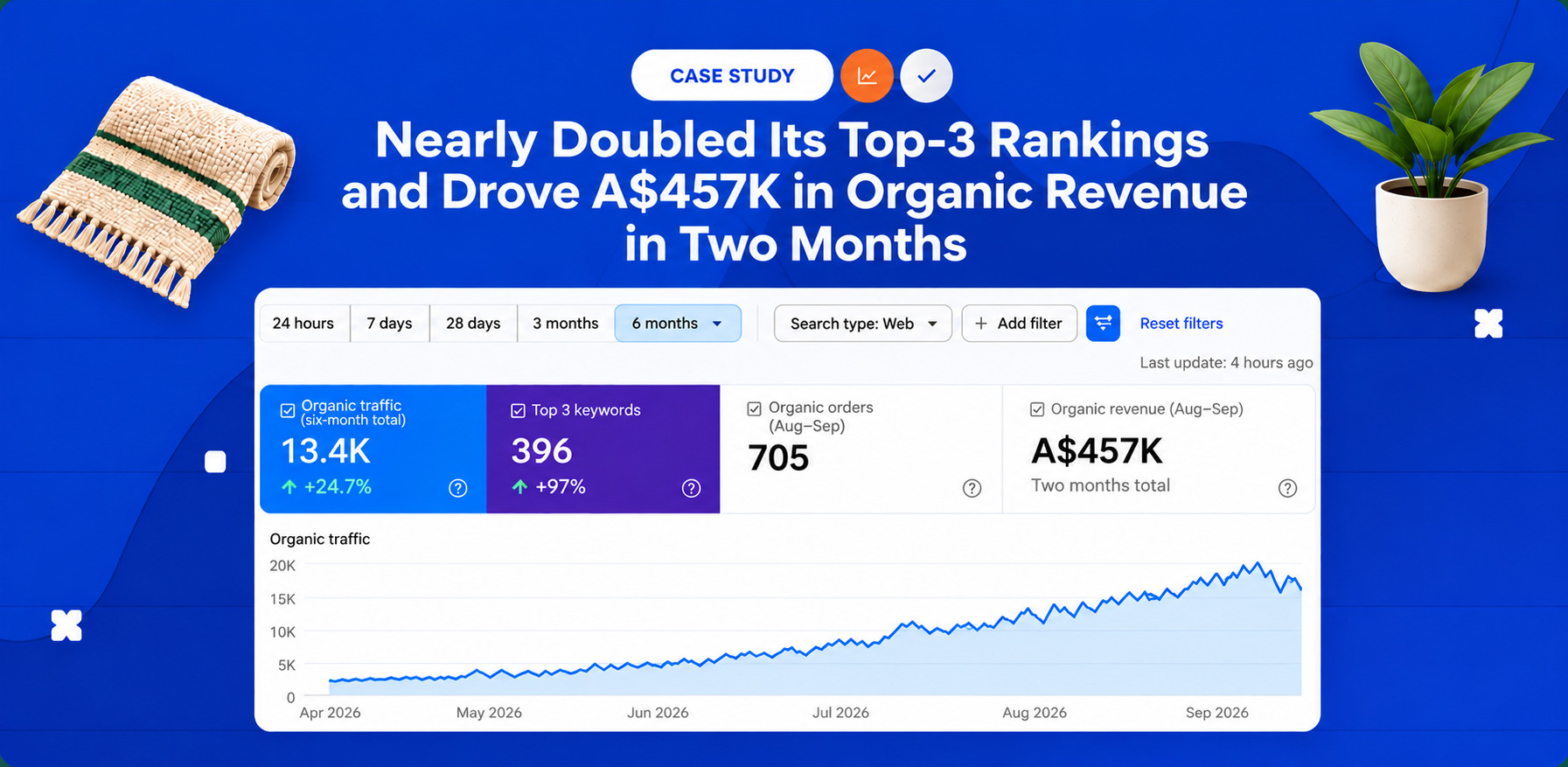
See how we helped an Australian rug brand increase non-branded organic traffic by 55%, achieve nearly 5x the conversion rate of paid advertising, and turn organic search into a valuable revenue channel.

"Within the first 3 months of working with them, they had us ranking the 1-3 spots for keywords that we thought were out of reach." — Abby, the Rug Brand's team, unprompted Trustpilot review
Search data from Semrush, October 2026. Revenue and cost data from Triple Whale, August 1 to September 30, 2026.
The client is a direct-to-consumer (DTC) rug brand founded in Byron Bay in 2022. The brand serves customers across Australia and New Zealand, and has plans to expand into the US and the UK. It currently runs two lines of products:
The premium line currently drives close to half of the revenue. Also, no other Australian brand offers washable premium natural fibers.
Despite the edge that the brand has, the competition around both lines is strong. In the polyester category, it competes with established names like Ruggable, Miss Amara, and Loopsie, and when it comes to natural fibers, it competes with Armadillo and Nordic Knots, both of which have far more brand history.
When we first reviewed the brand’s site in April 2026, we noticed that organic traffic had been declining for months, and the brand was heavily reliant on paid advertising.
Our initial assessment also revealed weaknesses in technical SEO, content, backlinks, and organic traffic. The website scored between 2 and 4 out of 10 across these categories on our internal scorecard.
The website did not have a well-defined structure for collection pages. This left the homepage to target broad, competitive keywords like "rugs" and "washable rugs."
The problem here is that users making these searches often have clear shopping intent. Someone searching for “washable rugs” typically wants to browse a selection of washable rugs, not land on a homepage and have to navigate through to the right products. Google also prefers a dedicated collection page for a shopping search.
Competing brands already had dedicated collection pages targeting these searches. This put the brand at a disadvantage when competing for visibility across its main product categories.
The page, “Organic Cotton Kids Rugs”, outranked the main collection page, “Kids Rug”, which is actually the more relevant page for broader searches like “kids rug”.
In the runner-rug category, two separate collection pages were targeting the same keyword.
This is called keyword cannibalization. When two pages on your site target the same keyword, Google ends up ranking one of them lower than it would rank a single page. You end up competing with yourself.
Other than the problem with the structure of the collection pages, our initial technical SEO audit uncovered important issues that needed attention. We found:
We also found that products had two different URLs, which split their ranking signals. Worst of all, there was an old "SEO Manager" app that quietly overwrote page titles on the site whenever the team published them.
Together, these issues made it harder for search engines to understand content on the site. These issues also disrupted how pages were indexed and accessed, and weakened the ability of the brand to compete for valuable search terms.
The brand was also competing against businesses that had years of press coverage and a stronger online presence. These businesses had been building backlinks and authority for years.
Backlinks are links from other websites that signal credibility and relevance to Google. Google reads them as votes of trust. The client did not have a strong backlink profile, and as such, they were at a disadvantage when competing for highly competitive category keywords.
Even with a good page structure and proper optimization, it’s difficult to outrank established competitors with more trust signals and authority.
Our first priority was to improve the collection page structure and ensure that key product categories have dedicated pages that target relevant search terms. Here’s what we did:
The client's team approved the first collection copy within days.
"Super super minor feedback added to the collection page content. Otherwise approved! Great job," their marketing lead wrote in June.
The client already had its own developer, marketing lead, content team, and brand lead. Instead of taking over the entire process, we worked alongside the in-house team with clear responsibilities on each side.
We handled the strategy, audits, technical SEO work, content briefs, and link building. The client’s team implemented the changes, often within days. In the first sprint, their developer fixed the missing headings, installed an alt-text app, resolved the broken pages, merged the duplicate product URLs, and removed the outdated SEO Manager app that had been overwriting page titles.
Through weekly updates, we made sure the client knew what we’d completed, what we were working on, and what we needed from their team.
"They are the most proactive agency I've ever worked with. We receive weekly updates clearly stating exactly what they need from us, what they've completed and what's coming." — Abby, Trustpilot review, September 2026
Expert Insight: How quickly SEO recommendations are implemented can make a real difference on the timeline of the results. In this case, the speed of execution was never a bottleneck in the process, as the team executed our recommendations fast.
Our guide on how long SEO takes to work will help you understand how execution speed influences the SEO timeline.
Our goal here was to strengthen the brand’s backlink profile and help it compete for more competitive keywords. Here’s what we achieved:
Source: Project link-building log, October 5, 2026.
Note: Domain Rating (DR) is a metric developed by Ahrefs that measures the strength of the backlink profile of a website on a scale of 0 to 100. The higher the score, the stronger the profile, and the more authority the site may carry in Google's eyes. Links from high-DR websites help strengthen a site's backlink profile and improve the brand’s ability to rank for highly competitive search terms.
We used DR alongside estimated monthly traffic to vet every opportunity. This reflects our approach to link building and digital PR. We prioritize quality, relevance, authority, and long-term SEO value over simply acquiring as many backlinks as possible. We never use private blog networks as they can put a site's search visibility at risk.
We continued with our technical SEO work even after the audit.
In August, the client removed a “How It Works” page, which caused broken links across the site overnight. We noticed the issue fast and quickly resolved it. We removed the broken links and agreed on this: tell us before you remove any page so we can set up redirects on the same day and send visitors and search engines to the most relevant alternative pages.
The client now has plans for a full redesign in February 2027. To prepare for this, we’re putting together a list of every product URL that’s currently earning traffic, a naming guideline for products, and a plan for redirects and pre-launch checks. We’ll hand these to the in-house design agency to help protect the existing search visibility during the redesign.
A redesign can affect organic rankings if important pages, URLs, or internal links are changed without proper planning. That’s why we’re protecting the SEO gains well before the redesign begins.

Figure: Semrush Organic Keywords Trend. Yellow represents positions 1–3, while purple represents positions 4–10.
We started working with the brand at the end of May 2026, and since then:
As the chart above shows, positions 4 to 10 barely changed, but the keywords getting into the top 3 almost doubled. This means more of the brand’s pages were climbing to the top of page one, where search results typically attract more clicks.

Figure: Semrush Improved Positions report, showing keyword ranking improvements over the last six months, sorted by monthly search volume.
As noted above, Semrush recorded improvements for 678 keywords over the last six months. The biggest improvements were for the high-value commercial searches related to the collection pages we'd prioritized in our SEO strategy.
See below.
Source: Semrush.
The above improvements are a direct result of the changes we made to the collection pages.
Because more of the brand’s product search terms were ranking among Google's top results, it was better positioned to reach potential customers actively searching for rugs.

Figure: Semrush organic traffic comparison, October 2025 to March 2026 vs. April to September 2026.
The brand also saw encouraging organic traffic growth when comparing April to September with the six months before.
Non-branded traffic refers to the visitors who searched for a type of rug (e.g., runner rug), not the brand's name. Non-branded searches accounted for approximately 67% of the brand's estimated organic traffic, up from 54% in the previous period.
This is the clearest sign the SEO strategy worked. Branded searches mostly come from people your ads already reached. Non-branded searches are customers that only search can bring in.
Authority grew alongside it. Backlinks rose 99.5%, and referring domains (the number of separate sites linking to the brand) rose by 51.4%.

Figure: Triple Whale SEO dashboard, August 1 to September 30, 2026.
Source: Triple Whale. All figures in Australian dollars.
In August and September alone, organic search brought in A$457,536 in revenue from 705 orders. The brand had invested A$11,000 in SEO for those two months.
That means for every dollar invested in SEO, the business generated A$41.59 in revenue from organic search. And with 705 orders attributed to organic search, that worked out to an average SEO cost of just A$15.60 per order.
The timing makes these results even more relevant. The client told us that August to October is their quietest season. The brand had also cut Google Ads spend in this period after finding Performance Max was its weakest channel. Despite all that, organic search kept delivering.

Figure: Triple Whale organic search customer journeys, August 1 to September 30, 2026.
Source: Triple Whale.
According to Triple Whale, 233 orders worth A$139,283 came from Google organic search alone. Organic search also played a role in another 188 orders across the other customer journeys shown above.
For example, some shoppers first discovered the brand through Meta or Google Ads before visiting through organic search. Others found the website through Google search and later returned through paid advertising before making a purchase.
Note that most customers looking for products that cost hundreds or thousands of dollars research first before they buy. Organic search was helping the brand reach and reconnect with shoppers at different stages of their purchase decisions.
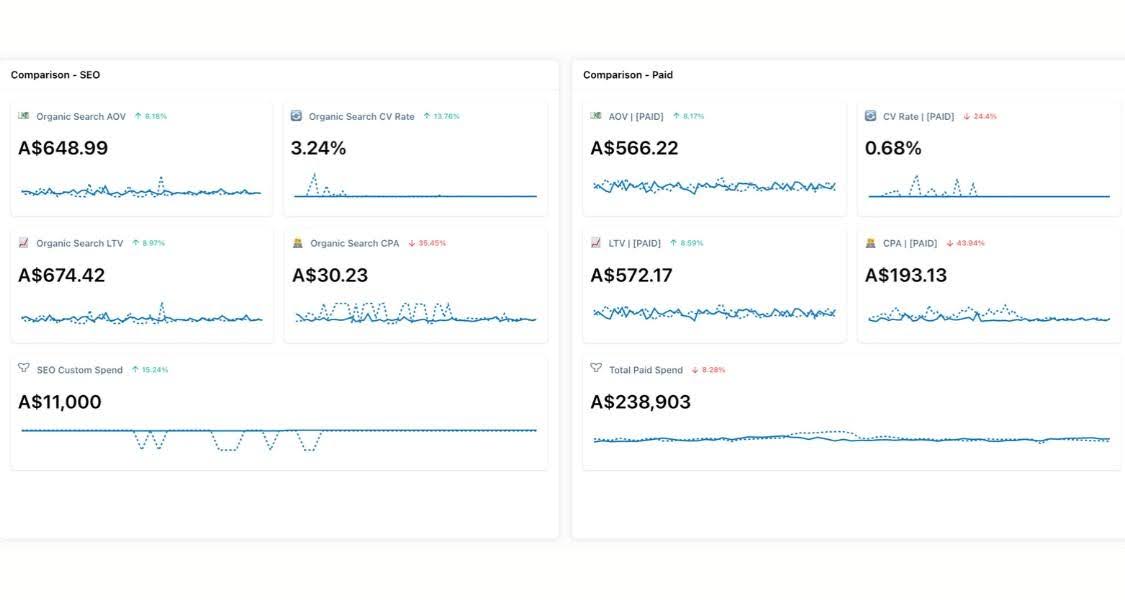
Figure: Triple Whale, SEO vs. paid advertising, August 1 to September 30, 2026.
Source: Triple Whale. The SEO cost per customer is calculated by dividing SEO spend by organic orders.
Organic visitors converted at almost five times the rate of paid visitors and spent more per order. This came from an SEO budget of A$11,000, while paid spend was A$238,903. Note:
One particular collection page did not follow the pattern. The homepage had been ranking for “washable rugs”. We had gone in and created a Washable Rugs collection page, expecting Google to favor the new page for those searches, as it had done with the kids, runner, and jute rug collections. However, Google continued favoring the homepage.
So in August, we changed our strategy. We moved our effort back to the homepage and optimized it for those searches, and we retained the new page to see if it gains traction over time. Consolidation usually works, but a homepage with years of authority for a brand's core category can be hard to move.
Testing, evaluating performance, and changing course beat defending the original plan. We used the ranking data to reassess our strategy and focus our efforts where they were more likely to make a difference.
Shoppers searching for a specific product typically want to browse a relevant collection page rather than a homepage. Building a clearer collection-page structure was one of the most important decisions in this engagement, although we also learned that an established homepage can sometimes be the stronger option for certain searches.
Multiple pages that target the same keyword can sometimes work against the site. In this case, merging the two runner collections took “runner rug” to position 3. Also, we redirected the organic cotton kids rugs page to the main kids rug collection, and “kids rug” climbed from position 6 to 2.
Growth in non-branded organic traffic is a clear sign that your site is gaining visibility for searches beyond your brand name. This means you’re reaching people who are actively looking for the products your brand sells. For our client, non-branded searches increased from 54% to 67% through organic search.
Higher rankings and more traffic are great, but they don't always translate into more sales. That's why it's important to measure how organic search contributes to revenue. In this case, organic search generated A$457,536 in attributed revenue over two months, with visitors converting at nearly five times the rate of paid traffic.
At DTC SEO Agency, we help direct-to-consumer brands compete against bigger, better-funded rivals. We combine technical SEO, link building, digital PR, content creation, and AI search optimization into one strategy.
If you:
Book a call, and we’ll take a look at your website, discuss what's holding back its organic performance, and identify opportunities to improve your search visibility.
More Case Studies: See how we helped a fine jewelry brand recover from a 75% traffic drop, and how we grew a new pet marketplace to 9,866 monthly organic visitors in six months.
Disclaimer: Client name has been anonymized at their request. Results reflect real outcomes for the featured brand. Search data from Semrush, captured in October 2026. Revenue data from Triple Whale, August 1 to September 30, 2026, in Australian dollars. Link and technical data from the engagement's delivery log.
Rehan has over 10 years of experience in SEO and digital marketing. He's especially good at Technical SEO and working with developers to implement technical improvements. He loves working with DTC SEO Agency because every client brings a different challenge. Solving those challenges is what keeps the job exciting.