

Building SEO Since 13 years Old. I didn’t set out to build an agency — I set out to solve a problem.
From the moment you started SEO, you've been opening Google Search Console, Google Analytics, or Ahrefs every week, watching the same thin line of organic traffic, and asking yourself questions that make you doubt your investment: Did I just waste money on this? How long does SEO take to see results?
This is one of the most common concerns we hear from founders and marketing teams investing in SEO for the first time. Unlike paid ads, traffic doesn't start flowing tomorrow. The frustrating part is that some agencies respond to this concern with vague statements like "it depends" without explaining what that actually means. And that's where the confusion starts.
In this guide, we'll discuss what actually determines your SEO timeline. You'll know exactly what to expect month by month, why SEO takes as long as it does, the signs that show your SEO is working long before revenue appears, and when to pull the plug with your current SEO agency.
We'll also walk through a real client example that shows how the right technical SEO, content strategy, and link building work can dramatically accelerate results when the foundations are already in place.
In the video above, we break down the biggest factors that influence SEO timelines and explain why some websites see results faster than others. Understanding those factors is the key to setting realistic expectations and avoiding costly mistakes. It's also one of the easiest ways to spot agencies making promises they can't realistically deliver.
We see this constantly with e-commerce brands that come to us after getting burned by an agency promising page-one rankings in 60 or 90 days. Search engine optimization (SEO) isn't a switch you turn on. It's a process of building trust, authority, and relevance in the eyes of search engines, and that takes time.
Warning: If an agency promises they'll get you ranking 1st in the first couple of months, tread carefully. We've analyzed an existing agency, not mentioning names, but their entire strategy was built on poor-quality backlinks that are over-optimized. This hikes up results in the first 3 months, after which they sell their client and lock them into a 1-year commitment. This agency has changed its name 3 times due to the poor reviews they receive once their spammy tactics have been recognized by the search engine, and the client’s site is tanking, so quick-and-dirty is not something you want in SEO. SEO is best when it's seen as building an asset; that's when you see the biggest ROI over time.
If your competitors have spent years building content, earning backlinks, and strengthening their authority, there's a lot of ground to make up before you can consistently outrank them across the board. With that said, with a well-designed strategy, you can see results from certain keywords and pages.
By the end of this guide, you'll be able to look at your website, your competition, and your market and make a reasonably accurate estimate of how long SEO is likely to take for your brand.
Let's get started. Here are the mechanics behind the SEO timeline.
Before your page can compete for any search ranking, Google's bots need to find it, crawl it, and add it to the index. That process alone can take anywhere from a few days to several weeks, depending on how frequently your site gets crawled and how well it's structured.
Once indexed, new pages don't immediately compete at full strength. Google puts them through what's commonly called a "sandbox" period. This is a testing phase where the algorithm evaluates whether a page is actually useful to searchers before committing to a stable ranking position. This period can last weeks to months.
Expert Tip: Once you publish new content, use Google Search Console (GSC) to manually request indexing and monitor your coverage report. This won't bypass the evaluation period, but it at least gets you into the queue faster. Also, for product and collection pages, it’s worth getting them live as soon as possible to let them age, even if they might not be a part of the initial scope.
Google isn't evaluating your page in isolation. It's comparing your content against every other piece of content targeting the same keyword, across numerous ranking signals, including:
Every single one of these takes time to accumulate and demonstrate. Think of it this way. Google is ranking trust as much as it's ranking content. Of course, trust takes time to build.
Ahrefs' research backs this up clearly. Over 72% of pages in Google's top 10 results are more than 3 years old. That’s a reflection of how Google weights the signals that accrue over time.
Unless it’s a novel product or concept, every keyword you're targeting already has established pages competing for it. Those pages have years of backlinks pointing to them, a history of content updates, and accumulated user engagement signals. You're competing against sites that have spent years building authority, earning backlinks, and growing their visibility. As such, you need to build enough authority to outperform sites that have been at this for years.
This is why keyword difficulty matters so much when you're deciding where to start. Going after a broad, high-volume term from day one is the equivalent of walking into a heavyweight boxing match six months into training. The smarter move is to build authority in the places where you can win first.
Note: Ahrefs studied 2 million pages and found that only 5.7% ranked in the top 10 within one year for at least one keyword. That's not a reason to quit, it's a reason to start now.

No two websites are on the same timeline. Here's what actually moves the needle, and what slows it down. Understanding these factors is how smart operators compress a 12-month timeline into 6.
An older domain with an established backlink profile will rank faster than a brand-new site.
This isn't really about age itself. Google doesn't reward a domain just for being registered for a long time. What matters are the signals that accumulate over time:
A domain with even modest authority (say, a DR 30 with a few hundred referring domains) can start seeing meaningful SEO results in 30 to 90 days with strong execution. Domain Rating (DR) is an Ahrefs score that estimates a site's backlink profile and authority on a scale from 0 to 100. Higher scores generally indicate stronger authority. A brand-new site with a DR of 0-5 may need 6 to 12 months before organic traffic becomes a significant channel.
If you're launching a new DTC or B2B brand, factor this into your expectations. You're building from zero.
Keyword competition is one of the factors that influences how quickly you can rank, but keyword difficulty (KD) should only be used as a directional metric. Most SEO tools calculate KD largely based on backlink data. The problem is that the sheer number of backlinks doesn't tell the whole story. We've seen keywords with high KD scores where the top-ranking competitors are relying on spammy or low-quality links. We've also seen competitors ranking exceptionally well with very few backlinks because they have a stronger domain rating (DR) or content.
That's why we always evaluate the actual search results rather than relying solely on a keyword difficulty score. When assessing an opportunity, look at the top 10 ranking pages and analyze:
The timeline to rank depends far more on the strength of the pages already ranking than on the KD score shown in a tool.
As a general guide, long-tail and lower-competition keywords often produce results faster than broad, highly competitive terms. However, the real answer comes from analyzing the SERP and identifying where competitors are vulnerable and where genuine ranking opportunities exist.
For most e-commerce website owners, the right starting point is almost always product-specific and buyer-intent keywords. These are the searches your customers make when they're ready to buy, not the broad category terms that attract everyone from researchers to journalists to competitors.
For example, targeting a product-specific relevant keyword like "personalized gold necklace with initials" will see results far faster than going after "necklaces." One is mid-to-low competition; the other is high competition and very high volume.
Google's goal is to surface the result that best answers a searcher's query. Content that fully addresses search intent (with the depth, structure, and specificity that the query deserves) outperforms thin, generic content every time.
The problem we see most often in the existing content of DTC brands is that it's optimized for the brand's internal language rather than for how customers actually search. We find thin collection pages with no explanatory content, blog posts that cover a topic at the surface level, and meta descriptions pulled from the homepage.
One piece that genuinely earns its position compounds over time. It attracts natural backlinks, ranks for related long-tail queries, and gives Google more signals that your domain is authoritative on the topic.
That's why our content creation process starts with understanding search intent, analyzing what already ranks, and identifying the gaps competitors haven't addressed. We focus on creating content that serves the user first while covering the topics, questions, and supporting information Google expects to see. The result is content built to earn rankings and keep them.
Backlinks are external links from other websites pointing to yours. They function as votes of confidence, and they're the strongest off-page ranking signal Google uses.
As noted earlier, a site with zero backlinks is operating at a structural disadvantage. It can produce great content and fix every technical issue and still rank below a weaker page on a more authoritative domain.
Proactive link building through digital PR, editorial outreach, and niche partnerships can compress timelines meaningfully. This is because you'll be earning trust signals faster than they would organically accumulate.
One Critical Note: Link quality matters far more than quantity. A single link from a high-authority, relevant site outweighs 100 directory listings or spammy guest posts. In some cases, low-quality or over-optimized spammy links can create short-term ranking gains, but they also increase the risk of future ranking volatility and can become difficult to recover from. The same applies to Private Blog Networks (PBNs). While some PBNs can temporarily boost rankings, they rely on owned or controlled websites created primarily to manipulate search results. They’re inherently risky and difficult to scale sustainably. Sites that become dependent on PBN links often face significant challenges if those links are deindexed, removed, or lose value over time. We focus on editorial placements for our clients because that's where the ranking leverage actually lives.
Think of your technical SEO foundation as the floor beneath everything else. A weak, broken foundation has issues, such as:
If your site has these technical SEO issues, no amount of great content or strong backlinks will fully compensate. Technical issues act as a ceiling. They limit what your other SEO efforts can achieve, and they're often invisible unless you're specifically looking for them.
Page structure is a great example. If a page lacks a clear H1 and supporting H2s, search engines have a much harder time understanding what the page should rank for. You can have great content on the page, but if it's not structured correctly, its performance will be limited.
Think of it like a book. You wouldn't read one without a title, and it would be hard to navigate without chapters; search engines work similarly.
We saw this firsthand with the jewelry brand featured later in this guide. Part of the growth came from improving the structure and optimization of key collection pages. This made it easier for search engines to understand the pages and rank them for relevant commercial keywords. Combined with technical SEO improvements and strategic link building, this helped increase top-3 rankings from 53 to 677 in six months.
If you're working with our technical SEO team, we conduct a comprehensive audit in Month 1 because we need to fix technical issues before we scale the rest of the campaign. Then we run a monthly crawl to ensure no technical issues are holding you back.
Note: There’s a lot of ongoing work on websites, with many different teams working simultaneously. Hence, websites need ongoing checks, as redesigns by a CRO team or the installation of an app can cause technical issues.
Learn more about this in our guide: CRO and SEO: How to Balance Rankings and Conversions Without Killing Performance
Where you're starting from shapes everything about your timeline.
Moving from position 30 to position 10 is a very different challenge than moving from position 10 to the top 3. A site with zero SEO history starts from scratch; a site that's been publishing content, even unoptimized content, has a baseline of indexed pages, some link equity, and existing keyword signals to build on.
Some of our fastest wins come from brands that have been established for years but have never had a structured SEO strategy. The underlying authority is already there. We simply need to optimize existing pages, fix technical issues, and close the gap between them and their competitors.
In our YouTube discussion above, we shared an example of a client whose site already had strong foundations in place. By focusing on technical SEO, page and content optimization, and strategic link building, we doubled their organic search revenue from just under £400,000 to £800,000 in around 4.5 months. The site wasn't starting from zero, which allowed us to move much faster than we could with a brand-new website.
The gap between strategy and execution is where most campaigns slow down. SEO recommendations that sit unimplemented for three months push your results back three months.
For instance, we've had clients who didn't want to change an H1 or SEO title on a product page because they were concerned about the brand. The reality is that you can still rank, but it often takes much longer. The key is finding a good middle ground between optimizing pages for search and maintaining your brand voice. There are always other elements we can work on, but including target keywords in the right places will usually deliver the quickest results.
As such, the speed of your SEO team's implementation, your link-building outreach, and how often and consistently you publish new content all directly affect your SEO success. Note that investing more resources doesn't always produce faster results. SEO has compounding dynamics that reward consistency over time. However, under-resourcing your execution, on the other hand, is a reliable way to unnecessarily extend your timeline.
This is one reason fully managed SEO tends to outperform DIY or partially managed approaches. There's no bottleneck or wait time between strategy and execution. But execution is only as good as the strategy behind it. It takes a skilled team with different experts to get the keyword mapping right, optimize pages properly, identify content opportunities, and secure quality backlinks that actually make a difference.
Here's what a structured, properly executed SEO campaign actually looks like, month by month. Use this section as a reference when you're evaluating whether your own SEO is on track or assessing what a new agency is delivering.
It's also worth remembering that this timeline assumes you're following sustainable SEO best practices. While some agencies use black hat SEO tactics to chase quick wins, those shortcuts often lead to ranking losses, penalties, or unstable results that don't last.
Month 1 is entirely infrastructure. A serious SEO engagement in Month 1 looks like this:
At DTC SEO Agency, we focus heavily on optimizing high-priority product and collection pages so they start picking up for the right keywords.
Note: Month 1 is about setting up the infrastructure; don’t expect any traffic improvements or SEO results.
Month 2 continues implementation and begins building momentum from the work completed in Month 1. On-page SEO improvements for existing high-value pages, ongoing technical fixes (broken links, crawl errors, page speed issues, header tag structure), internal linking improvements, and the continuation of content production. This is also when you start seeing improvements in Search Console's crawl coverage report. Google is starting to understand your site better, and you start picking up for new keywords.
Month 3 is when content publishing starts accelerating. Some pages begin appearing in Search Console impressions. If you’ve set up new products or collection pages in month 1, we would expect them to gain some traction by picking up keywords. Existing pages worked on since month 1 should either climb a few positions for keywords they’re already ranking for and/or pick up for new ones.
Note: This timeline assumes the site isn't currently ranking well. If your site is already ranking on page two or at the bottom of page one for valuable keywords, results can happen much faster. In those situations, a few strategic on-page improvements, technical fixes, or high-quality backlinks can be enough to move a page from positions 9–14 into the top 3, where the majority of clicks happen.
Don't interpret this as failure. It's exactly what good SEO execution looks like at this stage.
For DTC brands focusing on Shopify SEO, Months 1–3 are critical. Getting structured data, collection page optimization, initial backlink execution, and internal linking right early creates momentum that can accelerate rankings in the months that follow.
This is where results start to become visible, but expect fluctuations (especially for new pages that pick up) as the search engine algorithm performs its evaluation. Focus on the overall trend rather than week-to-week movements.
Organic traffic starts to tick up in this time frame. Low-volume, high-intent keywords, the ones your customers use when they're ready to buy, begin converting. Digital PR and link-building outreach from the previous months start yielding placements, and those backlinks begin influencing ranking factors.
In this phase, SEO investment starts making sense to stakeholders. SEO can also help other marketing channels perform stronger.
This is where SEO starts compounding.
The content you published in the early months has had time to accumulate backlinks, engagement signals, and ranking history. At the same time, your growing authority helps newer content rank faster. This is often when competitive mid-range keywords break into the top 10 Google search results.
Organic search also becomes a meaningful revenue channel during this stage. It may not be your largest acquisition source yet, but you can clearly measure its contribution and model future growth with more confidence.
In this phase, your SEO strategy starts showing up in both ranking and revenue reports.
A year into your SEO campaign, the impact becomes difficult to ignore.
The content you published months ago continues driving traffic and revenue without additional ad spend. As your authority grows, new pages rank faster, and competitors who neglected SEO often find themselves trying to catch up.
For e-commerce brands, this is where organic search starts operating as a self-sustaining growth channel. It lowers customer acquisition costs (CAC), generates predictable traffic, and reduces your reliance on paid advertising.
Expert Insight: As mentioned in the video, Google's own representatives have stated that SEO can take anywhere from four months to a year to produce meaningful results. Any SEO specialist or agency promising #1 rankings in 30 days is setting unrealistic expectations.
SEO timelines vary from site to site, but here's a real example of what can happen when a brand already has some authority and the right SEO strategy unlocks it.
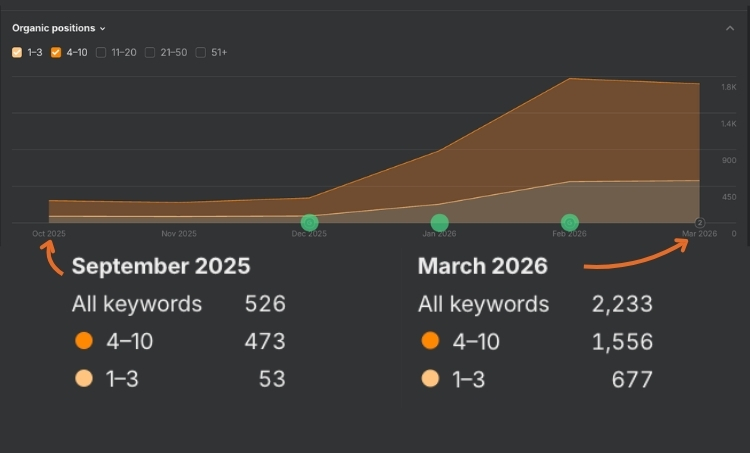
Screenshot from the client's Ahrefs account showing top 3 keyword rankings growing from 53 to 677 and total ranking keywords increasing from 526 to 2,233 over a six-month timeline.
In just six months, we helped the jewelry brand increase:
This result didn't happen because we found a shortcut. It happened because we fixed technical SEO issues, improved collection page content, recovered valuable backlinks, and executed a consistent DTC SEO strategy.
Want to see exactly how we achieved these results? Read the full Jewelry Brand SEO case study.
Google makes thousands of algorithm updates per year. Hundreds of those are significant enough to shift rankings meaningfully. A Core Update can reshuffle the first search engine results page overnight for competitive keywords.
It's important to note, however, that most major updates are designed to improve the user experience and reward the signals Google already values: helpful content, strong site quality, and trustworthy backlinks. Brands that focus on serving users well are generally more resilient to these updates, while sites relying on shortcuts or loopholes are often the ones most affected.
Also, brands that stop active SEO work don't stay at their peak rankings. Instead, they slowly cede ground to competitors who are continuing to adapt. Active SEO is what lets you catch these shifts early and adjust before a traffic decline becomes a revenue problem.
Every piece of content your competitor publishes is a potential threat to your current rankings. Every link they earn strengthens their position relative to yours. Backlink building never ends; it's an ongoing process with a competitive dynamic.
Content also has a shelf life. A blog post that ranked well 18 months ago may have been overtaken by a competitor who published something more comprehensive, more current, or better matched to how search intent has evolved. Without active content maintenance (refreshing, expanding, and updating existing pages), search engine rankings erode.
This means:
The brands that win at organic search treat SEO the way they treat paid ads — as a channel that requires consistent investment, testing, and optimization. The difference is that the assets you build in SEO appreciate over time. Google Ads stop generating traffic the moment you stop paying. SEO doesn't; it compounds.
You can't hack Google's timeline, but you can work intelligently within it. These are the highest-leverage moves to compress your SEO runway without cutting corners:
If you're working with or evaluating an SEO agency, don't just ask "how long does SEO take?" Ask whether the agency is doing the right things to get you there. Focus on their first 90-day plan, before rankings have moved, and what they're measuring.
If you're also evaluating budgets and deliverables, read our guide on how much SEO costs in 2026 to understand what transparent, results-focused SEO should look like.
At DTC SEO Agency, our fully managed SEO engagements are structured around the opposite of this: monthly reporting tied directly to ROSI, transparent deliverable logs, and a roadmap built on where you are today. We focus on building sustainable organic growth, not chasing short-term ranking spikes.
If you're evaluating SEO agencies and want an honest assessment of your timeline, book a call with our team.
Most new websites need 6–12 months to see meaningful SEO results. They start with no authority, backlinks, or established rankings, so search engines need time to build trust.
That said, most of the brands we work with aren't starting from zero. They're established businesses with an existing website, some level of authority, and often previous SEO work already in place. In those cases, results can happen much faster because we're building on an existing foundation rather than creating one from scratch.
Local SEO often delivers results faster than national SEO, with many businesses seeing improvements within 3–6 months. Optimizing your Google Business Profile, maintaining consistent business information across directories, and earning customer reviews can all accelerate local search visibility.
Most Shopify stores start seeing early traction within 3–6 months when they have strong technical foundations in place. Site speed, collection page optimization, structured data, and internal linking all play an important role. In highly competitive industries, expect SEO to take longer to become a significant revenue channel.
No. Google Ads do not directly influence organic rankings. However, paid search campaigns can reveal which keywords drive conversions, helping you prioritize content and target the right search queries within your SEO strategy.
Important: While Google Ads won't make your pages rank faster, SEO and paid advertising often work best together. SEO is often the first touchpoint, helping potential customers discover your brand, while Google Ads and retargeting campaigns can help convert that interest into sales. Likewise, strong SEO can make your paid campaigns more efficient by increasing brand visibility and trust.
Look at leading indicators first. In the early months, monitor keyword rankings, new keyword growth, and technical score improvements in Ahrefs or Google Search Console. It’s very important to obsess over the right keywords that will drive traffic to those who want to buy. Over time, as keywords climb, you’ll see organic traffic grow and more revenue generated through organic search. A strong SEO campaign should show progress across all three. Continuously analyze what’s working, what could be improved, and whether you’re closing the gap to your competitors.
Your rankings won't disappear overnight, but they will often decline over time. Competitors continue publishing content, earning backlinks, and improving their sites. Without ongoing optimization, your organic search traffic and search engine rankings will gradually lose ground.
SEO and paid ads serve different purposes. Paid ads generate immediate traffic, while SEO builds a long-term asset that can continue driving traffic and revenue for years. For most e-commerce brands, the strongest approach is having a strong position in both SEO and paid acquisition. The brands that dominate their category rarely rely on just one channel.
Explore our e-commerce SEO case studies to see the long-term impact of SEO done correctly.
Highly competitive keywords can take months or even years to rank for, but the timeline depends heavily on your starting position. We've seen pages move into the top rankings within a couple of months when they were already ranking on page two and had a strong foundation in place. Book a call with us, and we’ll analyze your specific situation.
Yes, blogging can improve SEO performance. Publishing high-quality content helps build topical authority, target relevant keywords, and attract organic backlinks. Focus on creating content that matches user intent and answers real search queries rather than publishing content simply for volume.
Ranking fluctuations are common, especially for new content. Search engines often test pages in different positions before rankings stabilize. Other causes include stronger competitors, technical issues, algorithm updates, or content that no longer matches search intent. Google Search Console is usually the best place to start your investigation.
Another common reason rankings become volatile is keyword cannibalization. For example, you might have overlapping intent between collection pages, or a blog post competing with a collection page for a commercial keyword. Google then struggles to determine which pages to rank, testing them against each other, and neither page performs consistently well in the end. This is a common issue when a site lacks proper keyword research, mapping, and SEO strategy.
How long SEO takes depends on your starting point, keyword competition, content quality, technical health, and how fast you can execute. The SEO process never truly "ends," because Google never stops updating, competitors never stop doing SEO, and your business never stops growing.
The brands winning at organic search right now are the ones that treated it as a long-term revenue investment. They're building compounding assets — content that earns traffic for years, authority that makes every new page rank faster, and an organic moat that makes their competitors' paid ad spend look increasingly expensive by comparison.
For established brands, SEO is often about taking what already exists and pushing it further. The brands that consistently invest in technical SEO, content, and link building are the ones that strengthen their market position and dominate organic search over time.
If you're ready to start or pick up where you left off, book a free strategy call with DTC SEO Agency. We'll show you exactly where you stand, what a realistic roadmap for your business looks like, and what you can do to accelerate organic growth without wasting time on the wrong priorities.
