

Building SEO Since 13 years Old. I didn’t set out to build an agency — I set out to solve a problem.
Imagine you're a CMO or business founder looking for an SEO agency. Like most buyers, you shop around. The first agency quotes $500 per month, the second $3,000 per month, and the third comes back with a proposal for $12,000 per month.
At first glance, it's tempting to focus on price alone. After all, every business wants to minimize costs and maximize results. But SEO is different from many other marketing services. Unlike a one-time purchase, SEO is a long-term partnership built on trust. The agency you hire will influence your website's content, technical foundation, authority, and ultimately your visibility in search results. Choosing the lowest-cost option may save money upfront, but in some cases, cheap SEO can do more harm than good if the agency relies on the wrong tactics.
So when you're comparing SEO proposals, the question isn't simply, "Which agency is cheapest?" The better question is: “Which agency has the expertise, strategy, and track record to generate the highest return, not just the lowest cost?”
That's why SEO pricing varies so dramatically, and why understanding what's included is far more important than comparing monthly fees alone.
In this guide, we'll break down real SEO pricing ranges, explain what drives costs, uncover the warning signs of cheap SEO, and show you how to evaluate SEO through the lens that matters most: revenue potential, not just rankings.
In the video below, we break down why e-commerce SEO services can cost $5K/month in one niche and $15K+/month in another. The difference usually comes down to competition, authority gaps, content requirements, technical SEO, and how aggressively a brand wants to grow.
As explained in the video, search engine optimization (SEO) isn't a fixed product with a standard price tag. That's why you'll see one SEO agency charging $3,000 per month while another recommends $10,000 or more.
One of the biggest challenges we see with founders, CMOs, COOs, and CEOs evaluating SEO agencies is determining whether the proposed investment is actually justified.
SEO is a tricky space because results take time. You might not realize the quality of the work until it's too late. That's why it's important to understand what an agency charges and how they plan to deliver results.
Some questions you should be asking while evaluating SEO pricing include:
The answers to these questions often reveal far more about the value of an SEO proposal than the monthly price alone.
The six factors below will help explain why SEO costs vary so dramatically from one business to another.
One of the biggest misconceptions about e-commerce SEO pricing is that agencies are selling the same service at different prices. They're not.
When founders ask, "How much does an SEO agency cost?" they're usually expecting a straightforward answer. In reality, most agencies price SEO services based on how difficult it will be to compete in your market, what the service entails, and its quality.
Think about the difference between selling beard combs and selling GLP-1 supplements.
A beard-comb brand may be operating in a smaller niche with fewer established competitors and lower-authority websites. A company selling GLP-1 supplements is entering one of the most competitive search landscapes online, where major brands, publishers, and heavily-funded businesses are all fighting for visibility. GLP-1 is also a medical space, so the SEO strategy needs to cater to that. For instance, content needs to be expert-vetted and compliant.
The gap between those competitors and your website determines the investment required.
That's why two ecommerce brands can receive completely different SEO proposals, and both can be accurate.
At DTC SEO Agency, for instance, our pricing starts by analyzing the data connected to your business goals and the space you're operating in.
Our recommendations are driven by data. Before recommending an investment level, we analyze your content, backlink profile, digital PR presence, keyword landscape, and overall authority against the competitors you're trying to outrank.
The areas below are some of the key data points we evaluate when measuring that gap:
How much content do your competitors have compared to you?
A competitor with hundreds of optimized product pages, category pages, buying guides, and blog articles has built significant topical authority over time. Topical authority refers to Google's confidence that your website is a trusted source on a subject, making it easier for search engine algorithms to understand your expertise and relevance.
If your site has 50 web pages and the leading competitor has 500, there's a substantial content gap that must be closed through strategic content creation and ongoing optimization.
Note: Closing that gap requires high-quality content. Content that demonstrates expertise, aligns with search intent, and provides genuinely helpful and valuable information is more likely to support long-term SEO growth and strengthen your site's authority. Mass-produced AI content often lacks original insights, expertise, and the depth needed to compete in search results.
Learn more about this in our guide: Is AI-Generated Content Good for SEO? What Google Just Revealed in 2026
Backlinks remain one of Google's strongest ranking signals. The key isn't simply the number of backlinks, but the quality of those links.
A handful of links from respected industry publications often provide more value than hundreds of low-quality directory links. Brands with strong backlink profiles have spent years earning authority through digital PR, partnerships, and link-building campaigns.
That's why our approach to link building prioritizes quality, relevance, and authority — the same factors Google uses to evaluate the value of a backlink.
So if your competitors have significantly stronger backlink profiles, that directly impacts SEO pricing because closing that gap requires time, expertise, and resources.
Many businesses focus on content and backlinks while overlooking digital PR.
Brand mentions, media coverage, podcasts, industry publications, and expert features all contribute to overall authority. When Google repeatedly sees a brand being referenced across trusted websites, it strengthens the site's credibility.
This is often one of the biggest differences between mid-market ecommerce brands and the industry leaders they're trying to compete with.
Each website requires a different amount of work. A store with 50 products is very different from a store with 5,000 products. Larger ecommerce websites typically need:
As product catalogs grow, so does the complexity of the SEO campaign. This is one reason average ecommerce SEO costs are often higher than those of traditional small-business SEO.
Technical SEO is one of the most overlooked factors affecting SEO pricing.
Many agencies focus primarily on content creation while ignoring the technical foundation of the website. In our experience, this is one reason many businesses are disappointed with previous SEO providers. They received optimized blog posts but never addressed the issues holding the website back. Such companies only scratch the surface of SEO while neglecting technical fixes and informed growth strategies.
In short, the platform you're using can significantly influence SEO complexity and cost. For example:
Many brands also have technical debt that needs to be addressed before meaningful growth can happen. Technical debt is the accumulation of website problems and outdated implementations that make future SEO growth harder, slower, or more expensive.
Common examples include:
Before an SEO strategy can deliver results, these issues often need to be fixed first through informed technical SEO.
Businesses have different growth goals. Some founders are happy taking a steady approach to organic growth, while others want to aggressively capture market share as quickly as possible.
The faster you want to close the gap with your competitors, the more resources you typically need. Depending on your website, that might mean:
In simple terms, businesses that want to "hit the gas" usually require a larger monthly investment than those taking a slower approach.
Finally, e-commerce SEO pricing is heavily influenced by what you're actually buying.
One agency may offer SEO for $1,000 per month and only provide a handful of blog posts. Another may charge $7,000 per month and include:
On paper, both companies sell SEO services. In reality, they're delivering completely different levels of work.
That's why comparing SEO pricing without understanding the scope is one of the fastest ways to make a costly decision. Cheap SEO services often look attractive upfront, but when they fail to build authority, improve rankings, or generate revenue, they become far more expensive in the long run.
Now, let's look at the different pricing models for SEO in 2026.
Note: When evaluating how much seo costs, it's easy to focus on the monthly number and ignore how the work is actually being delivered. What’s included in the pricing model is what matters more.
Understanding the three most common SEO pricing models will help you compare proposals more effectively and avoid paying for a service that doesn't align with your growth goals.
Typical Range: $3,000–$25,000+ Per Month
Monthly retainers are the most common pricing model in the SEO industry and, for most DTC brands, they're the most effective. A typical monthly SEO retainer may include:
The biggest advantage of a monthly SEO retainer is that it enables continuous growth, since SEO isn't a one-time project.
Your competitors are constantly publishing content, earning backlinks, improving their websites, and building authority. If you stop investing while they continue, the gap between you and them often gets wider. This is especially true in competitive markets, where organic visibility is built through consistent execution over time.
Important: Be cautious with SEO retainers priced between $300 and below $3,000 per month.
At that price point, something usually has to be removed from the process. In many cases, that means little or no technical SEO, limited authority-building efforts, and content produced carelessly at scale with AI tools rather than guided by an experienced SEO strategy. Extensive use of automation and AI means you're risking your site's long-term performance and heavily compromising on quality.
Typical Range: $1,500–$30,000+ Per Project
Project-based SEO solves a specific problem rather than providing ongoing growth. Common examples of SEO projects include:
For example, if you're migrating from WooCommerce to Shopify, bringing in an SEO specialist for that project can prevent traffic losses and preserve rankings.
Likewise, a comprehensive technical SEO audit can uncover crawlability issues, indexation problems, and other technical barriers that are limiting growth.
The limitation is that project work eventually ends.
Once the audit is delivered or the migration is complete, competitors continue investing in their SEO while your momentum slows. That's why project-based SEO is often most effective when it's part of a broader long-term strategy.
Typical Range: $100–$300 Average Hourly Rates
Hourly SEO consulting is best suited to businesses that already have internal resources capable of executing recommendations. This model is commonly used by:
The benefit is flexibility. You gain access to experienced expertise without committing to a long-term retainer.
The challenge is execution. Advice alone doesn't improve rankings.
An SEO expert can identify opportunities, recommend technical fixes, and develop a strategy, but somebody still needs to implement those recommendations. Without execution, even the best SEO strategy remains a document sitting in a shared drive.
One of the most common questions we hear is: "How much should we budget for SEO?"
At DTC SEO Agency, our minimum retainer starts at $5,000 per month for lower-competition ecommerce brands and scales upward based on the level of competition, authority gap, technical requirements, and growth ambitions.
For brands operating in less-competitive niches, a typical investment ranges from $5,000 to $7,000 per month. In more competitive industries where a client wants to scale aggressively, businesses often invest $10,000 to $15,000+ per month to build the authority, content, backlinks, and digital PR required to compete effectively.
The reason we don't provide fixed pricing upfront is simple.
Before recommending an SEO marketing budget, we conduct a deep analysis of your website, competitors, keyword opportunities, backlink profile, technical SEO requirements, and revenue potential. We also assess whether SEO is a viable growth channel for your business. In some industries, search demand may be too limited to justify the investment, particularly when product margins or average order values don't support the potential return. Without understanding the opportunity available in the market and the gap between you and the competition, any SEO quote is just an educated guess.
The ranges below provide a realistic benchmark for what e-commerce SEO pricing typically looks like in 2026.
Typical SEO Budget: $3,000–$7,000 Per Month
These brands usually operate in highly specific product categories with relatively limited competition but with decent search volumes. Examples might include:
Because the authority gap is often smaller, the investment required to compete is lower. A typical SEO program at this level may include:
This is often enough to build momentum in niches where competitors have not invested heavily in SEO.
Typical SEO Budget: $5,000–$12,000 Per Month
Many e-commerce brands generating between $2 million and $10 million in annual revenue fall into this category. These businesses typically operate in established markets such as:
Competition is stronger, which means content, technical SEO, and authority building all become more important. At this level, businesses typically require:
Many brands at this stage choose a Fully Managed SEO service to bring technical SEO, content creation, link building, and digital PR together under a single strategy rather than managing multiple agencies or freelancers.
Typical SEO Budget: $10,000–$25,000+ Per Month
This level of investment is usually required when competing against major brands, national retailers, and established authority websites. These businesses often target highly competitive keywords, where competitors are continually investing in content, link acquisition, digital PR, and technical improvements.
At this level, SEO often requires a dedicated team that may include:
SEO campaigns may also include:
As explained in the YouTube video, businesses operating at this level are rarely competing against a handful of smaller websites. They're competing against brands with strong domain ratings (DR) that have spent years investing in SEO services.
At DTC SEO Agency, we start every engagement with a deep-dive analysis of your website, competitors, keyword opportunities, backlink profile, technical SEO requirements, and revenue potential before recommending a strategy.
Book a call today to discover what it will actually take to compete in your market — including the level of investment, services, and resources required to achieve your growth goals.
Or, browse our e-commerce SEO case studies to see what's possible with the right strategy and level of investment.
Every business is different, but our case studies can help you benchmark your own growth opportunities against brands facing similar challenges.

Many businesses pay for SEO while only receiving a fraction of what a full program requires.
A complete program should include:
Technical SEO should cover:
Platform-specific expertise is also critical for Shopify, WooCommerce, and Magento stores.
Content should focus on building topical authority. We research competitors' highest-performing content to identify gaps and opportunities. This helps us create content with new, helpful angles that provide greater value to the reader and strengthen topical authority.
This includes:
Many agencies rely heavily on AI or cheap outsourced writers. The result is often shallow content, poor heading structures, weak keyword mapping, and little long-term value.
Learn more about AI content in our guide: SEO Blog Content for E-commerce in an AI-Driven Search Landscape
Quality beats quantity. One editorial backlink from a respected publication can outperform dozens of low-quality directory links. Sustainable link building requires:
Note: The examples above are intended as general benchmarks. Some e-commerce businesses require additional support, such as international SEO, platform migrations, advanced technical SEO, or large-scale digital PR campaigns and reputation management. The right strategy depends on your goals, competitors, and growth ambitions.
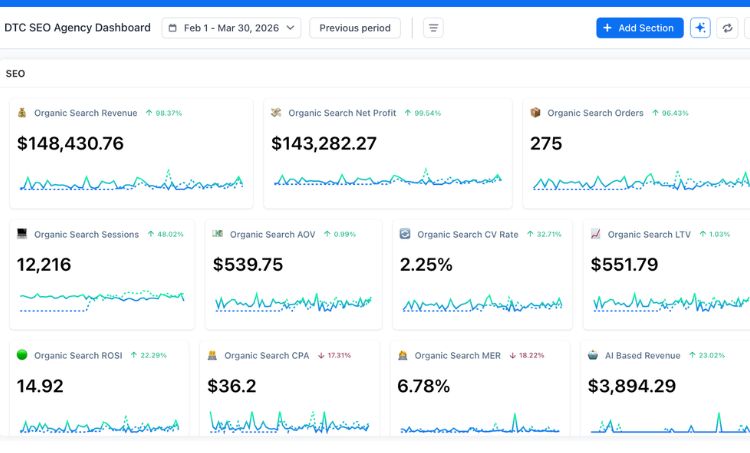
Instead of asking how much SEO services cost, a better question is: "How much revenue could SEO generate?"
SEO is often one of the most cost-effective customer acquisition channels when executed properly. Unlike paid Google ads, which stop producing results the moment spending stops, SEO continues to generate website traffic, leads, and revenue long after the initial investment.
Let's assume:
Here's what that could look like:
And that's from just one keyword; imagine the whole cluster of keywords, and then all the products the online store sells.
As your website gains authority and more pages begin ranking, dozens of keyword clusters can generate traffic simultaneously. That's why SEO has a compounding effect over time. If done right, you’re building up an asset that holds value.
To estimate the potential upside of your SEO investment, use our free SEO ROI Calculator to forecast potential returns.
Many 360 marketing agencies say they do SEO, but only scratch the surface.
Also, AI-generated content has made cheap SEO packages easier to sell than ever. The problem isn't that AI is inherently bad. It's that many agencies rely on AI-generated articles without adding expertise, original insights, fact-checking, or strategic keyword targeting. The result is often content that sounds great when you skim through it, but lacks the depth required to compete in search, and when you actually read it, parts of it don’t make sense. If something seems too good to be true, it usually is.
Common red flags of cheap SEO work include:
One of the biggest risks with cheap SEO is that the damage isn't always immediate. Poor content, weak backlinks, and non-strategic optimization may not hurt rankings overnight. Especially, backlinks can actually be toxic to your site, and excessive amounts of generic content can damage trust with the search engine.
In many cases, the consequences only become visible after a while. Six to twelve months later, you realize traffic hasn't grown, competitors have pulled ahead, or rankings have declined. By then, valuable time has been lost.
Most companies have at one time turned to freelance marketplaces, hoping to reduce SEO marketing costs. There's nothing wrong with hiring freelancers. The challenge is that content creation without an SEO strategy leaves your website struggling to catch up in the long-run.
Interestingly, almost every time we review content produced by writers hired through freelancing platforms, we find the same issues:
Weak and cheap SEO content doesn't compound. It accumulates, and over time, you end up with dozens (or even hundreds) of blog posts that, in the best-case scenario, contribute very little to your SEO campaign. They could also do nothing, or even worse, they can damage your site.
The helpful question about how much SEO costs is whether the investment is being directed toward the right specialist who can provide the desired Return on SEO Investment (ROSI).
If you're paying for SEO, make sure you're investing in a strategy built to drive results. Explore our DTC SEO and B2B SEO services and know what it takes to increase visibility, generate qualified traffic, and grow revenue through organic search.
The best seo services for e-commerce brands typically range from $5,000 to $25,000+ per month. The price should be dependent on the competition, website catalog, and business goals.
Yes. An SEO cost calculator can help estimate the required investment based on your goals, competition, and growth targets. You can also use our SEO ROI Calculator to forecast the potential revenue and return on investment from organic search.
Yes. In lower-competition niches, SEO efforts can become one of the highest-ROI marketing channels available because traffic compounds over time rather than disappearing when ad spend stops.
Most brands see ranking improvements within 3–6 months, especially if you have a site where trust has already been established and you’ve existed for a few years. Revenue-driving traffic often appears between 6–12 months, if the space is more competitive. Review this dog business e-commerce seo case study to see how long it typically takes.
Low SEO spend often leads to reckless AI content, minimal page and technical optimization, and low-quality or even spammy backlinks. Quality SEO includes technical work, link-building, digital PR, strategy, content creation, and revenue-tied reporting. A big differentiator is the strategic depth of the SEO roadmap and execution.
Freelancers can work well for small business owners and projects. However, most growing ecommerce brands benefit from an agency team that can handle technical SEO, content creation, link building, and digital PR within a single strategy.
Most audits range from $500 to $7,500+, depending on site size and complexity. If they propose solutions and strategic guides, they could become more pricey.
Link-building campaigns typically cost $250 to $1,000+ per placement when acquired through legitimate outreach and digital PR.
Yes, especially in low-competition niches and if you want to invest in learning SEO. However, SEO requires significant time and ongoing effort across content creation, technical SEO, link building, and optimization. You wouldn’t be able to cover a full SEO delivery on your own, since there are so many factors that affect SEO performance. For many founders, the better approach is to focus on product development and business growth while partnering with SEO specialists.
To choose an SEO agency for an e-commerce site, look for:
Avoid guaranteed rankings and vague deliverables.
SEO pricing ranges from $3,000 to $25,000+ monthly retainers because every business faces a different level of competition, complexity, and growth opportunity. Cheap SEO rarely compounds. Quality SEO does.
The brands paying $5,000–$15,000+ per month are investing in high-quality, human-first content, technical SEO, digital PR, authority-building, and long-term organic growth.
Before asking, "How much does SEO cost?", ask a better question:
How much revenue could organic search generate if your brand became the trusted authority in its category?
