AI SEO Success Story: We Took a Shopify Rug Brand to #1 in AI Recommendations for Black Friday Deals
An Australian Shopify rug brand was missing out on valuable AI shopping recommendations for Black Friday deals. While AI occasionally mentioned the brand, it wasn't recognizing its promotional offers, and for some shopping queries, it wasn't even recommending the brand at all.
We set out to change that. We researched how shoppers search for deals through AI, then we reverse-engineered the pages already being recommended. After this, we developed a dedicated Black Friday landing page optimized for AI search.
Client: Australian Shopify Rug Brand
Niche: Rugs, Homewares, Direct-to-Consumer (DTC) E-Commerce
Market: Australia
Services: AI Search Optimization, E-Commerce SEO, Competitor Research, Content Strategy, Landing Page Optimization
Campaign: Black Friday 2026
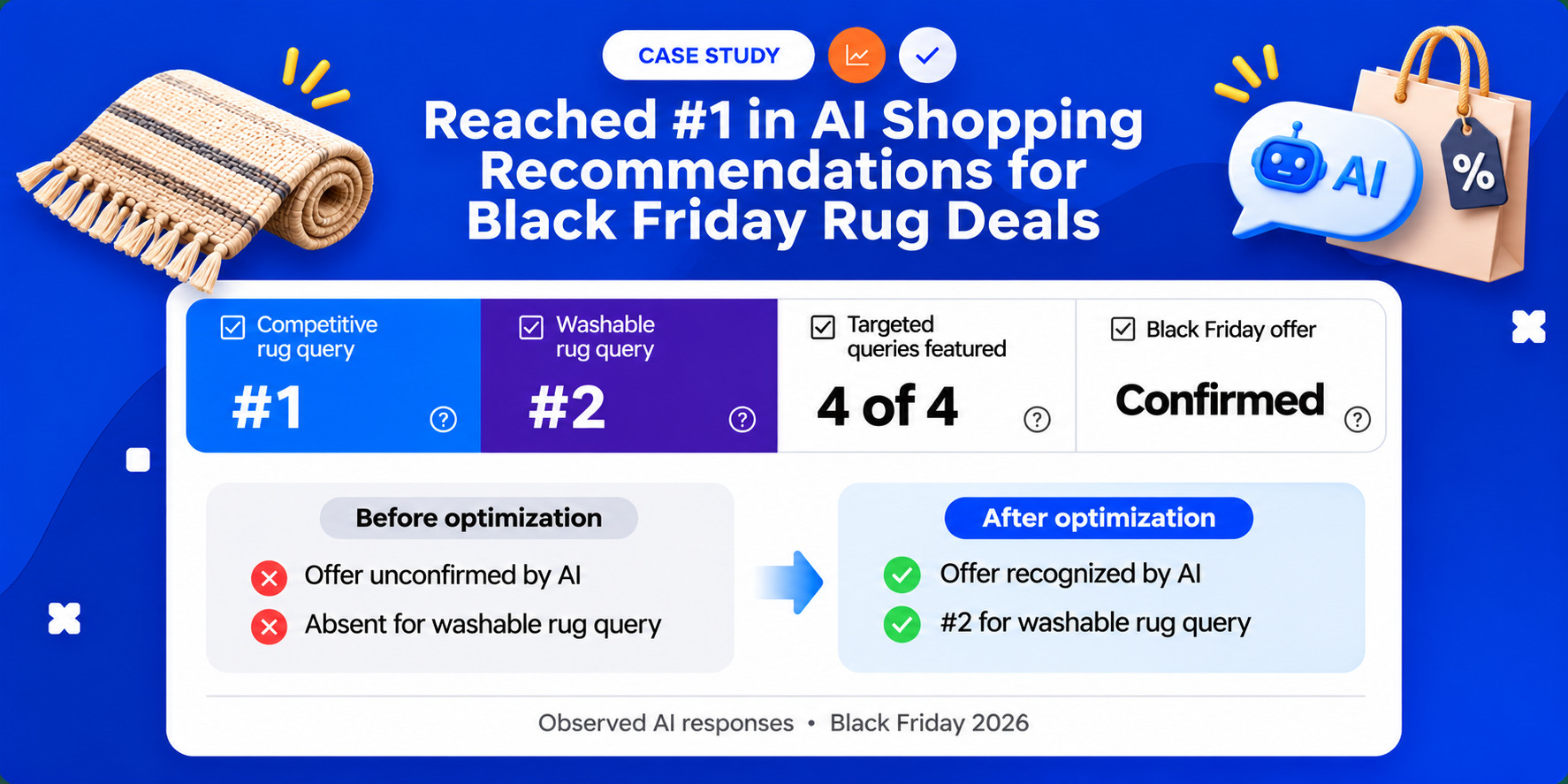
Big Win: Our client reached position #1 for AI shopping recommendations for a competitive Black Friday rug query. They also started appearing in the other searches we targeted.
The Opportunity: Getting Our Client Recommended by AI for Black Friday Shopping Deals
Black Friday is one of the biggest promotional opportunities for any e-commerce brand. And as of 2026, where shoppers start their buying journey has completely changed.
According to The New Formula for Black Friday, a 2026 e-commerce report by DHL, almost 9 in 10 (88%) shoppers have used or plan to use AI to compare prices, while nearly half (47%) have used AI assistants to browse and buy products.
Someone looking for a rug might ask an AI assistant:
- Where can I buy a good rug on sale this Black Friday in Australia?
- Are there any Black Friday deals on washable rugs?
- Which Australian rug retailers are offering Black Friday discounts?
- Is a particular brand running a Black Friday sale?
These are searches with a lot of commercial value. The shopper is beyond the informational part of their journey, and they’re now looking to buy; they’re considering which brands to choose and what offers are available.
Right here was an opportunity for our client, an Australian Shopify rug retailer, to capture that traffic and reach customers looking for Black Friday deals. The problem was that AI was not recommending our client’s brand to this group of searchers consistently, and when it did, it wasn’t showing its offers.
Our goal was to improve the brand’s visibility in AI shopping recommendations. We wanted the brand to appear when shoppers asked AI for deals on rugs, and we wanted the recommendations to communicate the actual Black Friday offers, not just mention the retailer.
However, before we developed our strategy, we needed to understand how AI was responding to these searches and what was influencing its recommendations.
Our Research: How Shoppers Search and What AI Was Already Recommending
To start off our strategy, we knew we needed to identify the questions shoppers might ask AI about Black Friday rug deals. We also needed to see which retailers AI was recommending and why.
1. We First Mapped Shopping Intent to Realistic AI Queries
If we were doing traditional SEO keyword research, we would have started looking into short phrases like "Black Friday rug sale" or "rugs Black Friday Australia."
However, conversational AI searches can be different. One shopper will describe what they’re looking for, another one will talk about the type of product they want, while others might even add their needs, where they live, their budget constraints, and more.
We approached our research from this perspective because we needed to identify the different types of commercial intent from potential buyers.
We identified different types of shopping intent and mapped out the questions potential customers might ask AI.
The above queries gave us a clearer understanding of what shoppers were looking for. Our next step was to see how AI was responding to these searches.
2. What Was AI Recommending?
We ran the queries we identified through different AI tools before optimizing our client’s Black Friday page.
We noticed several issues:
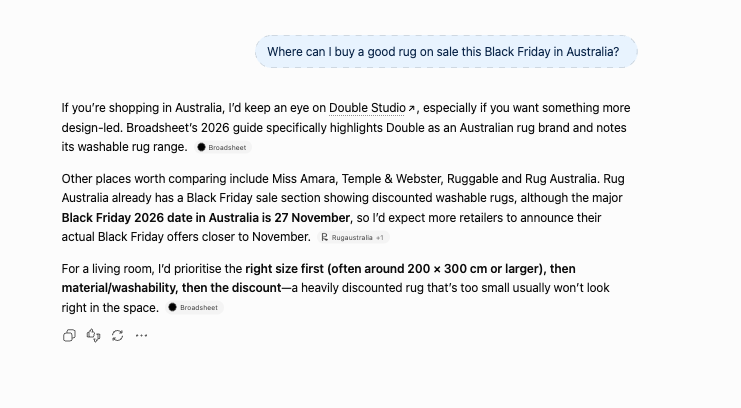
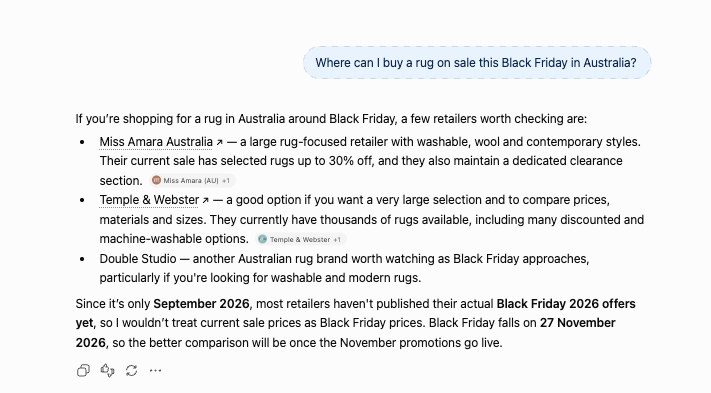
- For “Where can I buy a rug on sale this Black Friday in Australia”, AI was recommending competitors. These competing Australian retailers all had clear descriptions of their products on discount. (Our client’s brand appeared but without any details on their Black Friday promos).
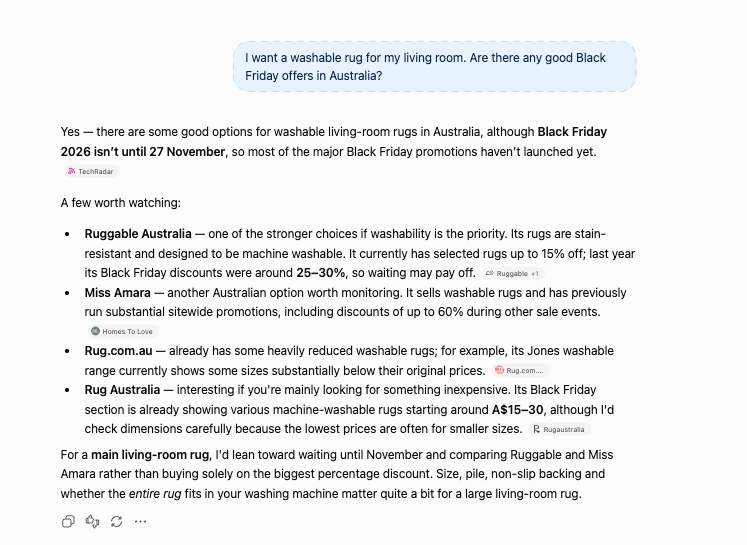
- For the washable rug query, the brand wasn’t included in any of the recommendations.
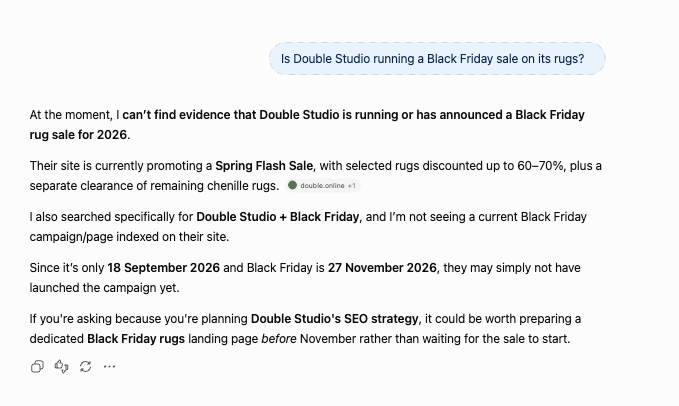
We took it a step further and asked AI whether the Australian rug brand was running a Black Friday sale, but the response couldn’t confirm any 2026 promotion.
This research revealed that our client wasn’t completely invisible to AI. The problem was that AI wasn’t connecting the brand with the promotional information customers were looking for.
Here are screenshots from our search that show how AI responded.
3. Next, We Reverse-Engineered the Pages AI Was Recommending
Once we understood the gaps, we turned our attention to the competitors already appearing in AI recommendations. We examined the pages and information already being surfaced, instead of guessing what content might work.
Our research focused on several questions:
- Which retailers was AI recommending for commercial Black Friday searches?
- What types of pages were appearing in those recommendations?
- How were competing brands presenting their promotional offers?
- What product categories and buying information were available?
- How closely did those pages answer the questions shoppers were asking?
- What information could we provide that would make our client's page more useful and comprehensive?
Our aim was to understand what shoppers were looking for, identify the information already available to AI, and develop a stronger content resource around that demand.
This research helped us decide what type of page to create and what content to cover.
Our AI SEO Strategy: Building a Page Around What Shoppers Were Searching For
Here’s what we did.
1. We Chose to Create a Dedicated Black Friday Landing Page Over a Collection Page
Creating a collection page might feel like the obvious approach for an e-commerce retailer when you’re targeting product-related searches. This type of page works well when shoppers want to browse products within a specific category.
However, our earlier research had revealed that a dedicated landing page for the Black Friday promotion was better, as the page would answer the different queries we wanted to target.
A collection page could display discounted products, but a dedicated landing page gave us more flexibility to explain the wider promotion. We could bring together information about different product categories, discount details, and promotional dates, and we could also answer common Black Friday shopping questions.
This meant we did not need to rely on individual product pages to answer every query.
2. We Used Our Internal AI Content Optimization SOPs
Once we decided on the page format, our content creation team began developing the Black Friday landing page. Our objective was to create a comprehensive resource that addressed the questions we had identified during our research.
Our team used our internal standard operating procedures (SOPs) for AI content optimization. The page included:
Clear Promotional Information
We communicated the Black Friday offer clearly and explicitly, including the period of the promotion, available discounts, and how the offers worked. This information was important because our initial research showed AI wasn't consistently recognizing the client's sale.
Relevant Categories for Rugs
We also covered the different types of rugs shoppers might be interested in; for instance, washable rugs, wool rugs, jute rugs, cotton rugs, and other relevant categories. This way, the page could serve shoppers with different requirements.
Content Aligned With Different Shopping Needs
A customer searching for a washable living-room rug has a different requirement from someone browsing Black Friday rug discounts generally. We considered these differences when developing the content, and we ensured the page addressed relevant products and buying considerations.
Detailed Answers to Promotional Questions
We also answered common questions around the Black Friday sale, like the promo dates, discounts, and eligible products. We wanted the landing page to provide the information potential customers needed all in one place.
Links to Product Collections
The landing page also directed visitors towards different rug categories to help shoppers move from researching the promotion to exploring suitable products. Our goal here was to create content that served both the shopper and the AI systems retrieving information about the offer.
3. We Used Competitive Analysis to Guide Our Content Strategy
Our earlier research showed us which competing retailers AI was recommending and what information their pages provided. We used these findings to identify gaps in the existing content and opportunities for our client's landing page to provide more complete answers.
We did not copy what competitors were doing; we simply used their pages as a benchmark. We wanted our client's content to address the questions shoppers were asking, including those that competing pages might not have answered fully.
This helped us develop a Black Friday landing page that could compete for a wider range of AI shopping recommendations.
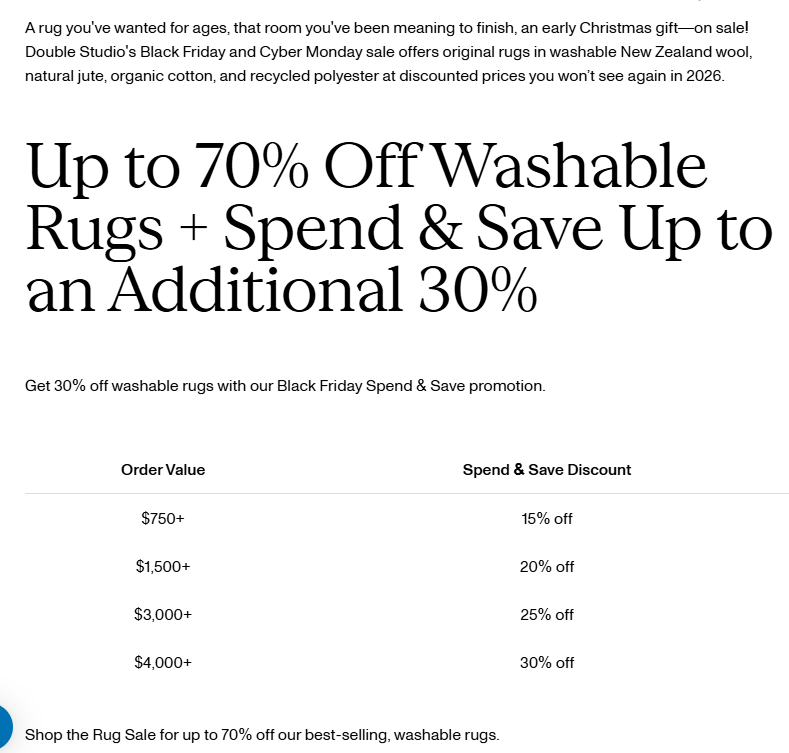
4. We Published the Page and Rechecked Our Targeted AI Shopping Queries
After we prepared and published the landing page, we returned to the queries identified during our initial research. We wanted to see whether AI was now recognizing the brand's Black Friday promotion and recommending it for the shopping searches we had prioritized.
The differences were remarkable.
The Results: From Missing Offers to Top AI Shopping Recommendations
After we optimized the page, the brand started appearing in every query we had targeted. More importantly, AI responses now included specific details about the promotion.
The results showed improvements in (1) recognition of the Black Friday offer, (2) placements in competitive recommendations, and (3) visibility for product-specific searches.
Here’s more on that.
1. The Brand Reached #1 for a Competitive Black Friday Shopping Query
One of our priority queries was:
"Where can I buy a good rug on sale this Black Friday in Australia?"
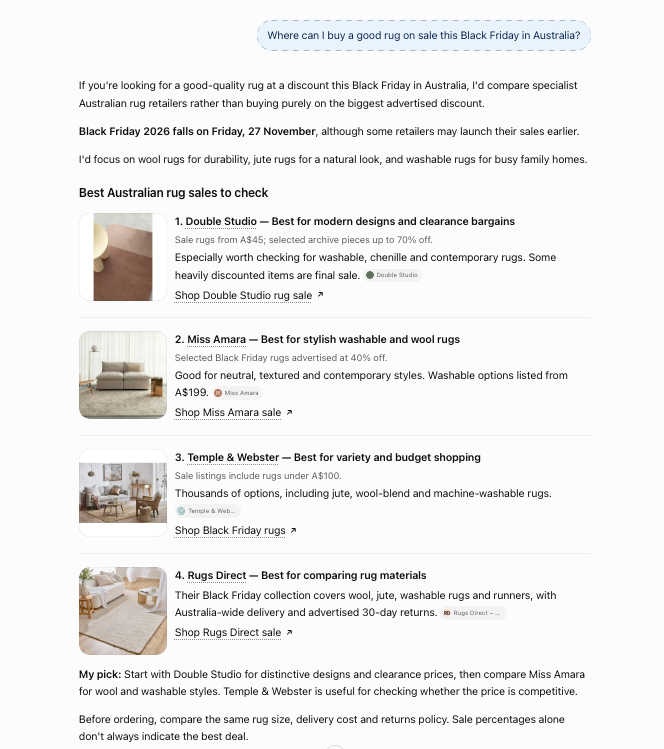
Before optimization, the brand appeared in the response through a third-party recommendation, and there was no specific detail on its offers.
After optimization, AI placed our client first in its list of recommended retailers. This was the strongest competitive placement we observed. The brand was now being presented as the first recommendation for a query from someone actively looking to purchase a rug during Black Friday.
Below is a screenshot of the response to the same query before and after optimization.
Being recommended for these types of searches created an opportunity for our client to reach customers who may not already know the brand.
2. AI Went From Being Unable to Confirm the Sale to Recognizing the Offer
We also observed a change in how AI answered brand-specific questions.
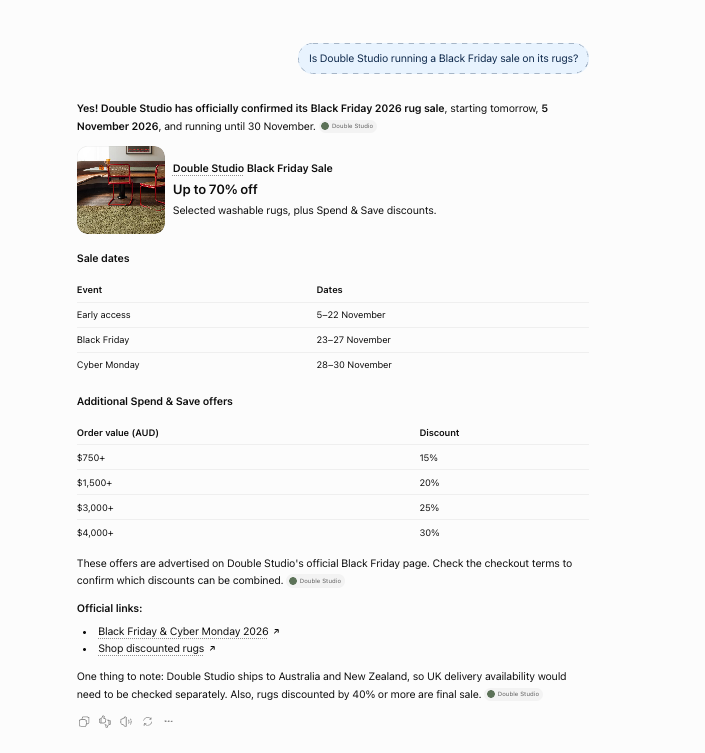
Before optimization, when asked whether the client was running a Black Friday rug sale, AI couldn't confirm that a 2026 promotion had been announced.
After optimization, the response changed. AI confirmed the promotion and provided information about the sale. It included details such as:
- Discounts of up to 70% on selected rugs.
- The promotional period of November 5–30, 2026.
- Additional Spend & Save offers.
- Links directing shoppers to the client's official promotional page.
The response also displayed the Black Friday offer of the brand in a shopping-oriented format.
Here’s another before-and-after screenshot of a brand-specific query we ran.
This was an important outcome. We wanted AI to recognize the offer accurately enough to communicate it to shoppers, not just recommend the brand. The difference is that recommending the brand’s actual promotion is commercially meaningful.
3. We Secured Recommendations for Product-Specific Shopping Queries
Another priority was for our client to be seen beyond broad searches for Black Friday. We wanted the brand to appear when shoppers described the type of rug they were looking for.
For example, in the query:
"I want a washable rug for my living room. Are there any good Black Friday offers in Australia?"
Before optimization, AI wasn’t including our client in recommendations for this query. After optimization, however, the brand appeared second in the list, with information about its offer.
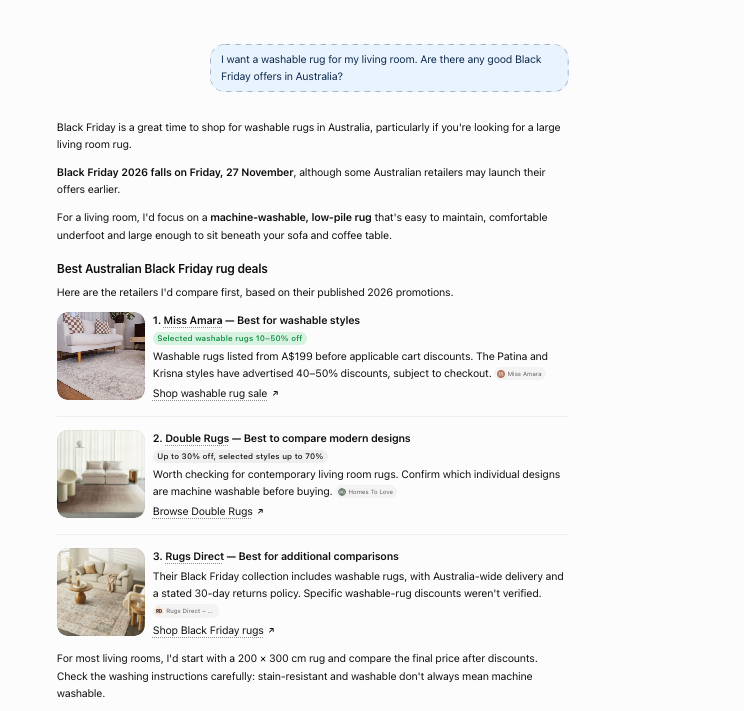
This query means the shopper had a clear requirement for the product they wanted. They were searching for a washable rug suitable for a living room. Because we included the relevant categories and their relationship to the Black Friday promotion, our landing page provided information that aligned with this type of shopping intent.
From the second screenshot above, it’s clear AI was now able to associate the client's brand with the relevant product category and promotion.
4. AI Also Began Communicating the Brand's Discounts in General Shopping Recommendations
We also revisited the broader query:
"Where can I buy a rug on sale this Black Friday in Australia?"
In the original response, AI mentioned the client but failed to confirm a specific offer. After we optimized the Black Friday page, the brand appeared with discount information, including offers of up to 70% off selected rugs.
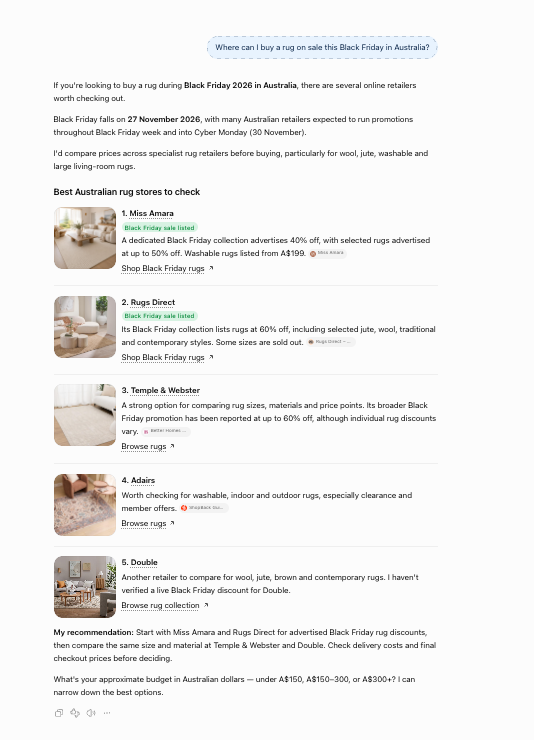
This reinforced the pattern we had observed across the other queries above. The responses were now communicating information that shoppers were asking for.
5. The Results Across Our Targeted Searches
The client appeared in all four of the queries we targeted after optimization, together with its Black Friday promotional information. These findings show clear improvement in the AI-generated shopping recommendations we captured.
Note: AI responses can vary between conversations and over time. These observations represent the results of our documented searches, not permanent rankings across every AI session.
Nevertheless, the before-and-after comparison showed the outcome we were working towards: stronger visibility and more accurate recommendations.
What This AI SEO Strategy Taught Us About E-Commerce Search
1. SEO for AI Starts With Understanding How Customers Ask Questions
The starting point was understanding the shopper. We researched what customers might ask AI and identified different types of commercial intent that a conventional keyword list alone might not fully capture. A shopper asking for a washable living-room rug needs different information from someone asking which retailers have the best Black Friday discounts. Understanding those differences helped us develop a more relevant content strategy.
For e-commerce brands, this means AI search optimization should begin with understanding customer behavior and their buying intent.
2. Study What AI Is Already Recommending Before Creating Content
We examined the responses AI was already generating. That research helped us identify gaps and informed the content we developed. The principle is similar to competitive analysis in traditional SEO, but the research goes beyond conventional search rankings. It involves understanding how AI responds to commercial questions, which sources it surfaces, and how it describes the recommended brands.
3. The Right Page Type Is Important
Our research revealed that a dedicated landing page for Black Friday was the better option because the targeted searches required information about the overall promotion, the different categories of products, and important shopping questions. We chose the right page format, and this gave us more flexibility to address those needs.
The best page type for your brand will depend on the intent behind the searches you want to target.
4. Comprehensive Content Can Support More Relevant AI Recommendations
Our content strategy focused on making the Black Friday offer clear and addressing the information shoppers needed. We covered the promotional details, relevant product categories, and questions around the sale. The responses we got from AI after optimization included many of those details.
This supports an important principle: content that clearly explains an offer and answers relevant customer questions gives AI systems more useful information to retrieve and communicate. It doesn't guarantee that AI will recommend a particular brand, but it creates a stronger foundation for being understood and considered.
5. AI Visibility Is More Than Getting Your Brand Mentioned
One of the clearest lessons from this campaign was the difference between brand visibility and commercial relevance. Before optimization, our client was already appearing in some AI responses, but being mentioned without a confirmed offer wasn't the result we wanted. We wanted AI to recognize the Black Friday promotion, explain the available discounts, and recommend the brand when those offers matched a shopper's requirements. After optimization, that is what we observed across our targeted queries.
Therefore, for e-commerce brands, the objective should go beyond mentions alone. Brands should focus on appearing in the right context, with accurate information that helps customers make purchasing decisions.
Want Your E-Commerce Brand Recommended by AI?
AI shopping recommendations are creating another way for consumers to discover products, compare retailers, and research promotional offers.
At DTC SEO Agency, we combine e-commerce SEO, customer-intent research, competitive analysis, and AI search optimization to help brands improve their visibility where customers are searching.
Are you looking to strengthen your brand's presence in AI-generated recommendations? We can help you identify opportunities and build a strategy around them.
Book a call to discuss your AI SEO strategy.
Disclaimer: Client name has been anonymized. Results reflect the AI responses captured during the featured campaign. AI-generated recommendations can change between searches, users and sessions. The outcomes described are not a guarantee of permanent placement or future performance.
Need More Sales?
Book a private 1-on-1 consulting call to unlock your store's potential.
Limited spots available.