Case Studies

How We Grew Top-3 Google Rankings by 277% for UK Radiators
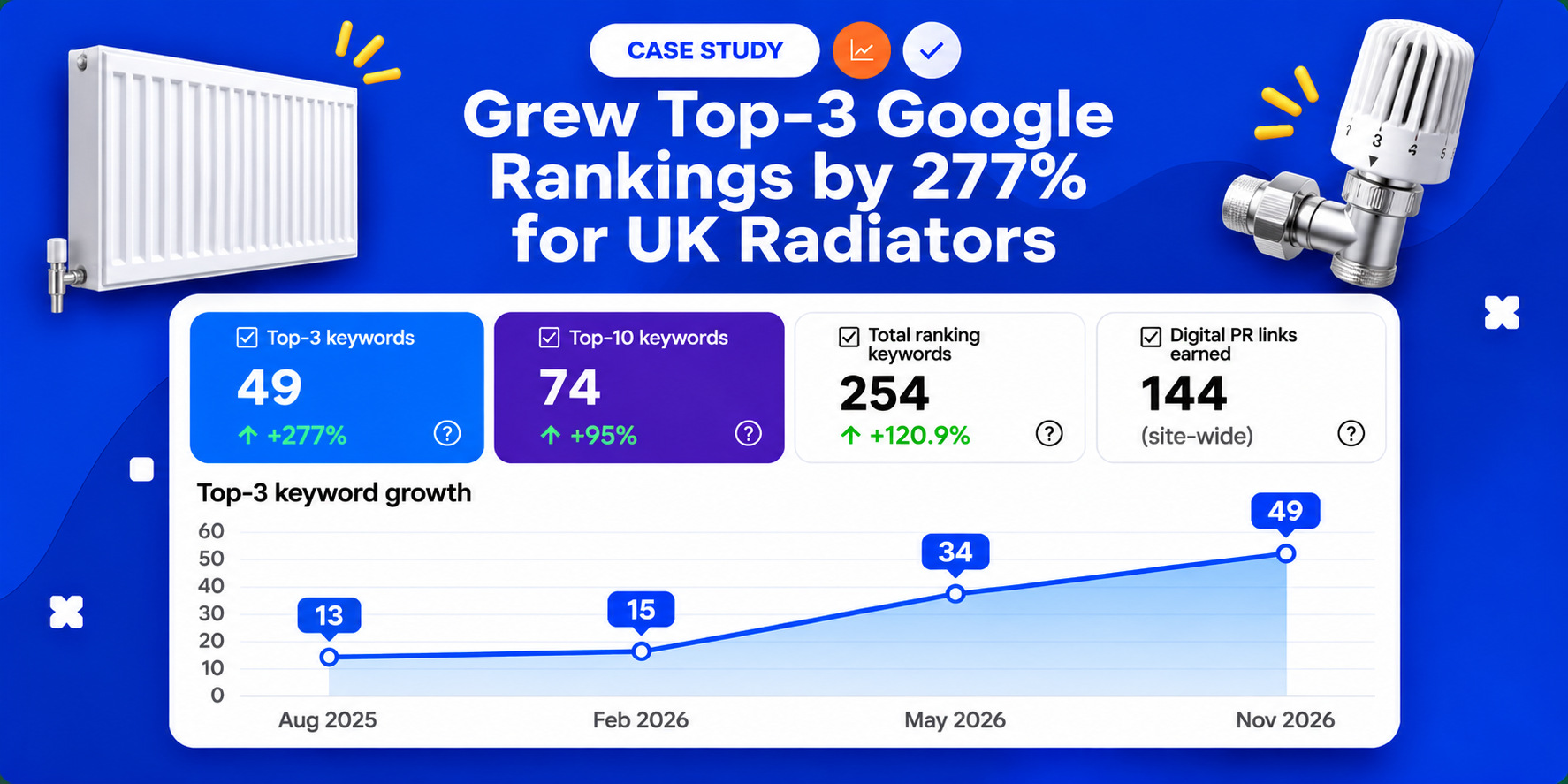
We started SEO work on UK Radiators in August 2025. As of November 2026, 49 keywords for a high-priority page sit in Google's top 3. This case study only highlights one of many pages worked on. 

  • Client: UK Radiators
  • Niche: Radiators and heating accessories, direct-to-consumer, Shopify
  • Market: United Kingdom
  • Page: Radiator Valves collection
  • Services: Technical SEO, On-Page SEO, Link Building, Digital PR
  • Timeline: August 2025 to November 2026 (ongoing)
  • Big Win: The keywords in Google's top 3 increased from 13 to 49, a 277% increase

Results at a Glance

Metric August 2025 November 2026 Change
Keywords in Google's top 3 13 49 +277%
Keywords in Google's top 10 38 74 +95%
Total ranking keywords 115 254 +120.9%

Source: Semrush Organic Keywords Trend for the Radiator Valves page, August 2025 and November 2026.

About UK Radiators

UK Radiators is a British online retailer for radiators. According to its own site, it has supplied over 250,000 homes in the UK, and it won the Allica Bank Great British Entrepreneur Awards. Its radiators have been featured in Good Housekeeping and The Guardian.

Radiators are a big-ticket sale, while their valves are the smaller part every radiator needs. As such, they have a large search market in their own right. "Radiator valves" alone gets around 12,000 searches a month in the UK.

That makes the Radiator Valves collection one of the brand’s most important pages. This keyword is also one of the hardest to win. Screwfix, a national trade retailer, held the top spots for this keyword, while RadiatorValves4U, a specialist, has the search term built into its domain name.

This meant that battling these already established retailers for the top three would be an uphill task.

The Challenge UK Radiators Faced and How We Solved It

The top 3 results on Google usually get most of the clicks. A page sitting at 5th or 6th for a search with 12,000 monthly searches is visible, but it earns a fraction of the traffic. The UK Radiators’ page had moved back and forth (for two years) between the top 3 and positions 4 to 10 for "radiator valves" and "radiator valve".

Here are some of the things that were holding the page back.

1. Competitors Had More Authority

In January 2026, we compared UK Radiator’s page with the two sites that were sitting above it. We noticed that Screwfix and RadiatorValves4U both had more backlinks pointing at their valve pages. RadiatorValves4U, specifically, had an exact-match domain.

  • Why This Mattered: Backlinks are links from other websites, and Google reads them as votes of trust. A page with more links of good quality usually outranks a similar page with fewer.
  • How We Handled This: We started link building for our client’s Radiator Valves page. Between August 2025 and March 2026, the page had earned backlinks from high-authority home, family, and lifestyle publications that wrote about radiator valves. Each one of these links added authority to our Radiator Valves page.

We also conducted a full digital PR campaign and earned 144 links to the UK Radiators website. This strengthened the authority of the site as a whole. In addition to this, we improved internal linking across the website so we could direct that authority toward priority pages like the Radiator Valves collection.

2. The Brand's Own Blog Was Competing With the Page

In March 2026, the page moved from 7th to 10th position, then to 21st. The problem was on UK Radiators' own site. A blog post titled "The Ultimate Guide to Radiator Valves" had been targeting the same keyword as the collection page.

Note: This is called keyword cannibalization. When two of your pages target the same keyword, Google can't tell which one to rank, and both end up ranking lower than one clear page would.

  • Why This Mattered: Someone searching "radiator valves" usually has the intention to buy. Because the blog had been written in a commercial way, it confused Google’s search engine, as it was competing for the same keyword as the collection page.
  • What We Did:
    • On March 27th (two days after spotting the blog), we reworded the introduction of the blog and reduced how often it used our target keyword. We ensured the guide answered questions, while, on the other hand, the collection page did the selling.
    • On April 14th, we redirected a URL for a broken thermostatic valve to the Radiator Valves page. Any authority that old link held went straight to the valves page.
    • We also cleaned up internal links across the site so that related pages could point clearly to the valves page.

But there was still one more problem.

3. Google Couldn't See the Products as Part of the Topic

Yes, the page had been gaining keywords overall (as of May 2026); however, it was still not holding the top 3 positions for its two main searches.

Throughout that time, Screwfix had stayed in the top 3. 

So we compared the two pages and noticed one main difference. The collection page for Screwfix had set every product title as a heading. UK Radiators' page had not.

  • Why This Mattered: Headings (H1, H2, H3…) tell Google how a page is organized and what it’s about. That is, if your product names, e.g., "thermostatic radiator valve" or "angled radiator valve", are headings, Google reads them as part of the page's topic and they tell it exactly what’s on the page.
  • What We Did: At our May 2026 monthly call with UK Radiators, we proposed marking up each product title on the collection page as an H3 heading. Dan, who runs the UK Radiators website, offered to implement the change on the Radiator Valves’ page.

The change went live on 28 May 2026. Our goal was to test this strategy on one page so that, in case rankings dropped, only one page was at risk, and we could easily correct it.

The Results: What We Observed

The results of our SEO strategy were quite remarkable.

1. Top-3 Rankings Nearly Quadrupled

Organic keyword growth from 115 to 254 between August 2025 and November 2026.
Figure: Semrush Organic Keywords Trend, two-year view. Since work started in August 2025, the page's ranking keywords increased by 120.9%.
Date Top 3 4–10 11–20 21–50 51–100 SERP Features Total
August 2025 13 25 13 45 15 4 115
February 2026 15 34 28 43 24 3 147
May 2026 34 44 26 41 24 9 178
November 2026 49 25 22 90 60 8 254

Source: Semrush, Organic Keywords Trend for the Radiator Valves page.

As noted in the table above from Semrush, keywords in Google's top 3 increased from 13 to 49 between August 2025 and November 2026. The total ranking keywords also more than doubled, from 115 to 254.

The first six months after we got started were quite slow. Top-3 keywords moved from 13 to 15 as we started earning links, then between February and May, after we fixed the cannibalization issue with the blog, they doubled to 34 and then kept increasing.

Semrush keyword ranking improvements for the radiator valves collection.
Figure: Semrush All Position Changes report showing improvements in keyword rankings. Keywords are sorted by monthly search volume.

The All Position Changes report also revealed another important thing. As seen above, “Radiator Valves” had the highest search volume, reading at 14.8k. UK Radiators ranked at position 2 for this keyword, while other large and relevant keywords are picking up and moving into the top 3.

2. The Heading Change Added Another 42.7% of Ranking Keywords

Organic keyword growth from 178 to 254 between May and November 2026.
Figure: Semrush Organic Keywords Trend, one-year view. In the six months since the page changed in May 2026, ranking keywords increased by 42.7%.

Within six months (after we changed the product titles to headings (H3S)), the total number of ranking keywords rose from 178 to 254. Top-3 keywords also increased from 34 to 49, up by 44%.

In the above figure, you can also see that the number of keywords in positions 4 to 10 fell from 44 to 25, while other keywords that had been sitting just below the top 3 moved up into it. Meanwhile, the keywords at positions 21 to 100 more than doubled, from 65 to 150. Those are new, longer searches the page had never ranked for before.

By our June 2026 call with UK Radiators, the page had more top-3 keywords than at any point in the previous two years. It ranked:

  • 2nd for "thermostatic radiator valve"
  • 3rd for "radiator thermostat" 
  • 4th for "radiator valves"

At the close of September, we told the client the page had made the top 3 for "radiator valves", "radiator valve" and "thermostatic radiator valve".

Do These Results Mean Every Collection Page Should Show Product Titles as Headings?

No, but in the case of UK Radiators, this was the biggest unlock for this specific page. Simply because you add headings will not make a page rank better by default.

We’ve seen clients lose rankings after a redesign removed product titles that used to show as headings. Headings can carry real weight, so before you add or remove them, here is what to look for.

1. Do Your Product Titles Fit the Collection?

Product titles only help if they cover the same topic as the collection page.

On Radiator Valves, for instance, every product name, from thermostatic to angled to straight, is a type of radiator valve. This means that as headings, they reinforced what the page was about and added topical depth.

However, if the products had not been named that way, they would have diluted the page instead. The Designer Radiators page is a good example. It contains different styles of designer radiators, and its product titles include colors, finishes, and other style choices. Some of the names do not include the word “designer”. 

If we turn those product names into headings, we would add confusion, not relevance. That’s why we rolled the change out page by page and never site-wide.
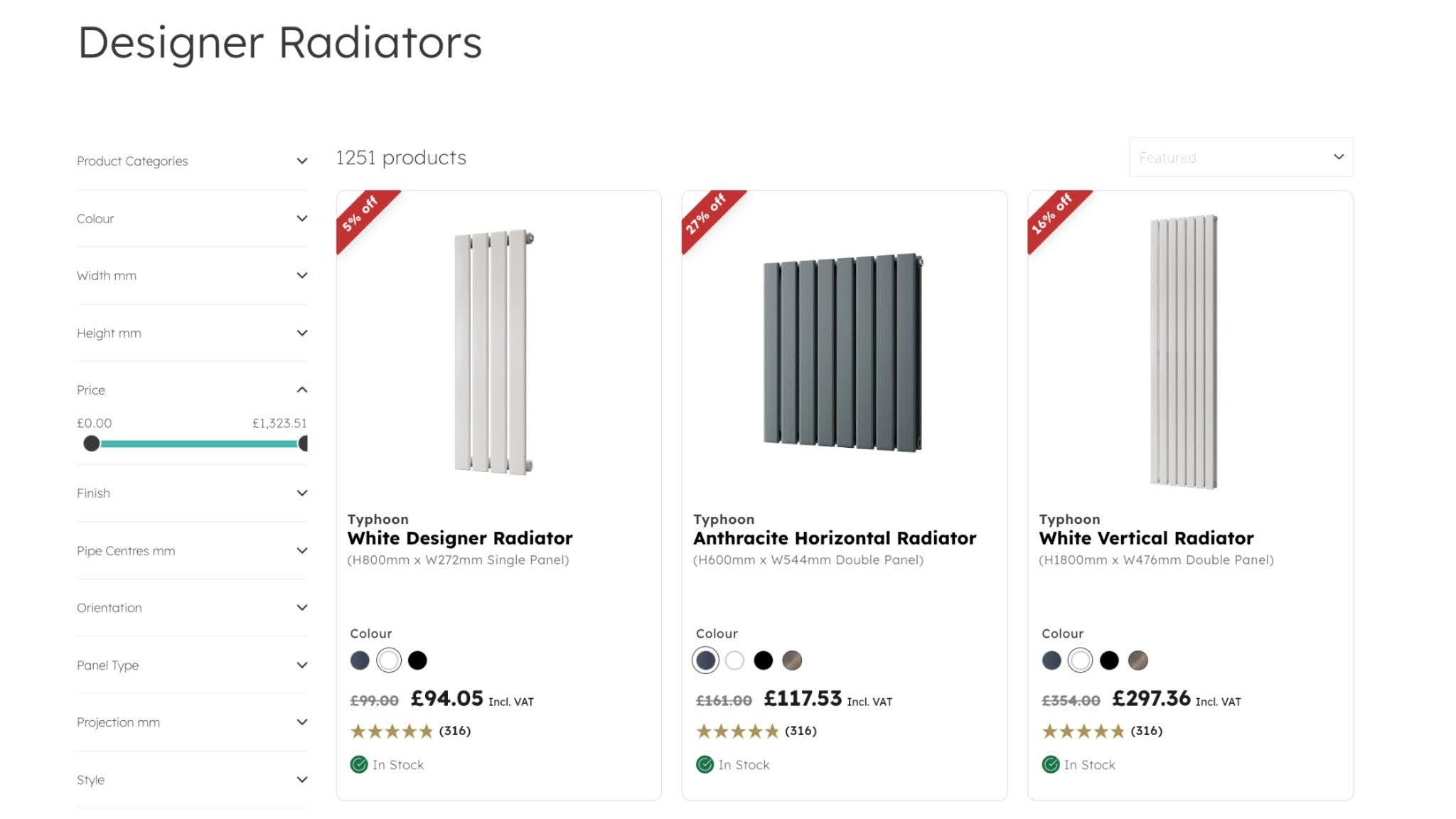
Designer radiators collection page featuring product listings and filters.
Image: Showing that products on the Designer Radiator collection page don’t have the main keywords “designer” in the product names. Which is why it would dilute the relevancy to change product titles to heading elements.

2. Check What Your Competitors Are Doing

We only ran this test because Screwfix, the page holding the top spot, was already doing it. Researching your top organic competitors page by page often shows what could unlock a page that has stalled. A big part of our strategy is competitor research.
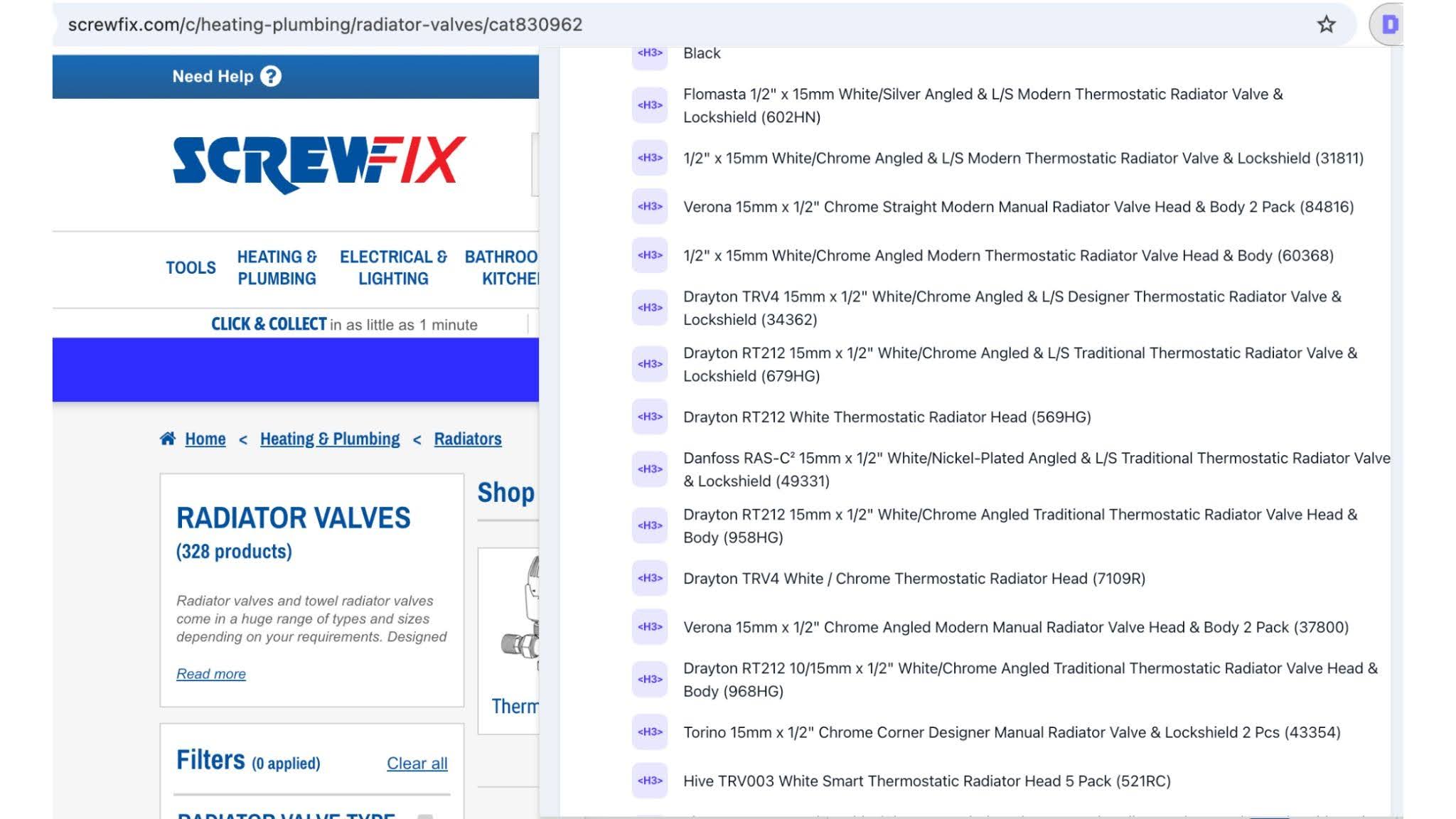
Screwfix radiator valves collection page showing H3 product headings.
Image: Using Detailed extension to look at a page structure, showing that Screwfix had their product titles coded as H3 elements.

3. Run a Test First

  • We tried the change on one page, and it worked.
  • We later tried the change on the Column Radiators page, and it had no clear effect. 

Testing one page at a time is what helps us tell two results apart. Don’t roll out a critical change site-wide if you have a large store with many products. A change you make to headings can have a massive impact on your site’s performance. Always roll out changes gradually and track performance.

And, It Was Never Just One Change

Our decision to change product names from normal text to H3 headings was the final push. Over the same period, we had been earning links; we also fixed cannibalization of the page with a blog, and we cleaned up the site’s internal links. A digital PR campaign also went live and earned 144 links to UK Radiators. In our case, the headings worked because the page already had the authority and focus to use them.

Three Takeaways for E-Commerce Brands

  1. Your Own Blog Can Take Your Best Search: A buying guide was competing with the collection page. Rewording the guide put the collection page at 1st within two weeks.
  2. Small Changes In Heading Structure Can Have a Massive Impact: Note that this will depend on context. Product titles as headings worked on Radiator Valves because every product fit the topic. On a page with mixed names, the same change would dilute it.
  3. Rankings Rarely Come From One Change: We executed a number of strategies (a digital PR campaign, earning links, fixing cannibalization, cleaning out internal linking) to build the authority of the page. The test worked because the foundation was already there.

Struggling to Break Into Google’s Top 3?

At DTC SEO Agency, we help direct-to-consumer brands compete against bigger, better-funded rivals. We combine technical SEO, content creation, AI search optimization, link building, and digital PR into one strategy.

If you:

  • Have collection pages stuck at positions 4 to 10 for your biggest searches
  • Compete with national retailers or exact-match domains
  • Have blog posts and collection pages that might be chasing the same keywords

Book a call, and we’ll show you which of your pages are closest to the top 3.

About the Author

Olivia Phillips, Co-Founder and CEO of DTC SEO Agency

Olivia was the client strategy owner on the UK Radiators account. She began her career as an engineer at a billion-dollar tech company, working across data, strategy, and management, and found her way into marketing almost by accident. What kept her there was the problem-solving: digging into the numbers and building systems that make results repeatable. Today she is building DTC SEO Agency to be not the biggest agency for organic growth, but the best. Every decision she makes for a client is anchored in data.

‍

Need More Sales?

Our proven SEO strategies drive traffic and boost sales.
Book a private 1-on-1 consulting call to unlock your store's potential.
Limited spots available.
Schedule Consultation
←  CASE STUDIES

How We Grew Top-3 Google Rankings by 277% for UK Radiators

‍

We started SEO work on UK Radiators in August 2025. As of November 2026, 49 keywords for a high-priority page sit in Google's top 3. This case study only highlights one of many pages worked on. 

  • Client: UK Radiators
  • Niche: Radiators and heating accessories, direct-to-consumer, Shopify
  • Market: United Kingdom
  • Page: Radiator Valves collection
  • Services: Technical SEO, On-Page SEO, Link Building, Digital PR
  • Timeline: August 2025 to November 2026 (ongoing)
  • Big Win: The keywords in Google's top 3 increased from 13 to 49, a 277% increase

Results at a Glance

Metric August 2025 November 2026 Change
Keywords in Google's top 3 13 49 +277%
Keywords in Google's top 10 38 74 +95%
Total ranking keywords 115 254 +120.9%

Source: Semrush Organic Keywords Trend for the Radiator Valves page, August 2025 and November 2026.

About UK Radiators

UK Radiators is a British online retailer for radiators. According to its own site, it has supplied over 250,000 homes in the UK, and it won the Allica Bank Great British Entrepreneur Awards. Its radiators have been featured in Good Housekeeping and The Guardian.

Radiators are a big-ticket sale, while their valves are the smaller part every radiator needs. As such, they have a large search market in their own right. "Radiator valves" alone gets around 12,000 searches a month in the UK.

That makes the Radiator Valves collection one of the brand’s most important pages. This keyword is also one of the hardest to win. Screwfix, a national trade retailer, held the top spots for this keyword, while RadiatorValves4U, a specialist, has the search term built into its domain name.

This meant that battling these already established retailers for the top three would be an uphill task.

The Challenge UK Radiators Faced and How We Solved It

The top 3 results on Google usually get most of the clicks. A page sitting at 5th or 6th for a search with 12,000 monthly searches is visible, but it earns a fraction of the traffic. The UK Radiators’ page had moved back and forth (for two years) between the top 3 and positions 4 to 10 for "radiator valves" and "radiator valve".

Here are some of the things that were holding the page back.

1. Competitors Had More Authority

In January 2026, we compared UK Radiator’s page with the two sites that were sitting above it. We noticed that Screwfix and RadiatorValves4U both had more backlinks pointing at their valve pages. RadiatorValves4U, specifically, had an exact-match domain.

  • Why This Mattered: Backlinks are links from other websites, and Google reads them as votes of trust. A page with more links of good quality usually outranks a similar page with fewer.
  • How We Handled This: We started link building for our client’s Radiator Valves page. Between August 2025 and March 2026, the page had earned backlinks from high-authority home, family, and lifestyle publications that wrote about radiator valves. Each one of these links added authority to our Radiator Valves page.

We also conducted a full digital PR campaign and earned 144 links to the UK Radiators website. This strengthened the authority of the site as a whole. In addition to this, we improved internal linking across the website so we could direct that authority toward priority pages like the Radiator Valves collection.

2. The Brand's Own Blog Was Competing With the Page

In March 2026, the page moved from 7th to 10th position, then to 21st. The problem was on UK Radiators' own site. A blog post titled "The Ultimate Guide to Radiator Valves" had been targeting the same keyword as the collection page.

Note: This is called keyword cannibalization. When two of your pages target the same keyword, Google can't tell which one to rank, and both end up ranking lower than one clear page would.

  • Why This Mattered: Someone searching "radiator valves" usually has the intention to buy. Because the blog had been written in a commercial way, it confused Google’s search engine, as it was competing for the same keyword as the collection page.
  • What We Did:
    • On March 27th (two days after spotting the blog), we reworded the introduction of the blog and reduced how often it used our target keyword. We ensured the guide answered questions, while, on the other hand, the collection page did the selling.
    • On April 14th, we redirected a URL for a broken thermostatic valve to the Radiator Valves page. Any authority that old link held went straight to the valves page.
    • We also cleaned up internal links across the site so that related pages could point clearly to the valves page.

But there was still one more problem.

3. Google Couldn't See the Products as Part of the Topic

Yes, the page had been gaining keywords overall (as of May 2026); however, it was still not holding the top 3 positions for its two main searches.

Throughout that time, Screwfix had stayed in the top 3. 

So we compared the two pages and noticed one main difference. The collection page for Screwfix had set every product title as a heading. UK Radiators' page had not.

  • Why This Mattered: Headings (H1, H2, H3…) tell Google how a page is organized and what it’s about. That is, if your product names, e.g., "thermostatic radiator valve" or "angled radiator valve", are headings, Google reads them as part of the page's topic and they tell it exactly what’s on the page.
  • What We Did: At our May 2026 monthly call with UK Radiators, we proposed marking up each product title on the collection page as an H3 heading. Dan, who runs the UK Radiators website, offered to implement the change on the Radiator Valves’ page.

The change went live on 28 May 2026. Our goal was to test this strategy on one page so that, in case rankings dropped, only one page was at risk, and we could easily correct it.

The Results: What We Observed

The results of our SEO strategy were quite remarkable.

1. Top-3 Rankings Nearly Quadrupled

Organic keyword growth from 115 to 254 between August 2025 and November 2026.
Figure: Semrush Organic Keywords Trend, two-year view. Since work started in August 2025, the page's ranking keywords increased by 120.9%.
Date Top 3 4–10 11–20 21–50 51–100 SERP Features Total
August 2025 13 25 13 45 15 4 115
February 2026 15 34 28 43 24 3 147
May 2026 34 44 26 41 24 9 178
November 2026 49 25 22 90 60 8 254

Source: Semrush, Organic Keywords Trend for the Radiator Valves page.

As noted in the table above from Semrush, keywords in Google's top 3 increased from 13 to 49 between August 2025 and November 2026. The total ranking keywords also more than doubled, from 115 to 254.

The first six months after we got started were quite slow. Top-3 keywords moved from 13 to 15 as we started earning links, then between February and May, after we fixed the cannibalization issue with the blog, they doubled to 34 and then kept increasing.

Semrush keyword ranking improvements for the radiator valves collection.
Figure: Semrush All Position Changes report showing improvements in keyword rankings. Keywords are sorted by monthly search volume.

The All Position Changes report also revealed another important thing. As seen above, “Radiator Valves” had the highest search volume, reading at 14.8k. UK Radiators ranked at position 2 for this keyword, while other large and relevant keywords are picking up and moving into the top 3.

2. The Heading Change Added Another 42.7% of Ranking Keywords

Organic keyword growth from 178 to 254 between May and November 2026.
Figure: Semrush Organic Keywords Trend, one-year view. In the six months since the page changed in May 2026, ranking keywords increased by 42.7%.

Within six months (after we changed the product titles to headings (H3S)), the total number of ranking keywords rose from 178 to 254. Top-3 keywords also increased from 34 to 49, up by 44%.

In the above figure, you can also see that the number of keywords in positions 4 to 10 fell from 44 to 25, while other keywords that had been sitting just below the top 3 moved up into it. Meanwhile, the keywords at positions 21 to 100 more than doubled, from 65 to 150. Those are new, longer searches the page had never ranked for before.

By our June 2026 call with UK Radiators, the page had more top-3 keywords than at any point in the previous two years. It ranked:

  • 2nd for "thermostatic radiator valve"
  • 3rd for "radiator thermostat" 
  • 4th for "radiator valves"

At the close of September, we told the client the page had made the top 3 for "radiator valves", "radiator valve" and "thermostatic radiator valve".

Do These Results Mean Every Collection Page Should Show Product Titles as Headings?

No, but in the case of UK Radiators, this was the biggest unlock for this specific page. Simply because you add headings will not make a page rank better by default.

We’ve seen clients lose rankings after a redesign removed product titles that used to show as headings. Headings can carry real weight, so before you add or remove them, here is what to look for.

1. Do Your Product Titles Fit the Collection?

Product titles only help if they cover the same topic as the collection page.

On Radiator Valves, for instance, every product name, from thermostatic to angled to straight, is a type of radiator valve. This means that as headings, they reinforced what the page was about and added topical depth.

However, if the products had not been named that way, they would have diluted the page instead. The Designer Radiators page is a good example. It contains different styles of designer radiators, and its product titles include colors, finishes, and other style choices. Some of the names do not include the word “designer”. 

If we turn those product names into headings, we would add confusion, not relevance. That’s why we rolled the change out page by page and never site-wide.

Designer radiators collection page featuring product listings and filters.
Image: Showing that products on the Designer Radiator collection page don’t have the main keywords “designer” in the product names. Which is why it would dilute the relevancy to change product titles to heading elements.

2. Check What Your Competitors Are Doing

We only ran this test because Screwfix, the page holding the top spot, was already doing it. Researching your top organic competitors page by page often shows what could unlock a page that has stalled. A big part of our strategy is competitor research.

Screwfix radiator valves collection page showing H3 product headings.
Image: Using Detailed extension to look at a page structure, showing that Screwfix had their product titles coded as H3 elements.

3. Run a Test First

  • We tried the change on one page, and it worked.
  • We later tried the change on the Column Radiators page, and it had no clear effect. 

Testing one page at a time is what helps us tell two results apart. Don’t roll out a critical change site-wide if you have a large store with many products. A change you make to headings can have a massive impact on your site’s performance. Always roll out changes gradually and track performance.

And, It Was Never Just One Change

Our decision to change product names from normal text to H3 headings was the final push. Over the same period, we had been earning links; we also fixed cannibalization of the page with a blog, and we cleaned up the site’s internal links. A digital PR campaign also went live and earned 144 links to UK Radiators. In our case, the headings worked because the page already had the authority and focus to use them.

Three Takeaways for E-Commerce Brands

  1. Your Own Blog Can Take Your Best Search: A buying guide was competing with the collection page. Rewording the guide put the collection page at 1st within two weeks.
  2. Small Changes In Heading Structure Can Have a Massive Impact: Note that this will depend on context. Product titles as headings worked on Radiator Valves because every product fit the topic. On a page with mixed names, the same change would dilute it.
  3. Rankings Rarely Come From One Change: We executed a number of strategies (a digital PR campaign, earning links, fixing cannibalization, cleaning out internal linking) to build the authority of the page. The test worked because the foundation was already there.

Struggling to Break Into Google’s Top 3?

At DTC SEO Agency, we help direct-to-consumer brands compete against bigger, better-funded rivals. We combine technical SEO, content creation, AI search optimization, link building, and digital PR into one strategy.

If you:

  • Have collection pages stuck at positions 4 to 10 for your biggest searches
  • Compete with national retailers or exact-match domains
  • Have blog posts and collection pages that might be chasing the same keywords

Book a call, and we’ll show you which of your pages are closest to the top 3.

About the Author

Olivia Phillips, Co-Founder and CEO of DTC SEO Agency

Olivia was the client strategy owner on the UK Radiators account. She began her career as an engineer at a billion-dollar tech company, working across data, strategy, and management, and found her way into marketing almost by accident. What kept her there was the problem-solving: digging into the numbers and building systems that make results repeatable. Today she is building DTC SEO Agency to be not the biggest agency for organic growth, but the best. Every decision she makes for a client is anchored in data.

‍

Ready to stop losing to better-ranked competitors?

One call. We'll map your specialty, your compliance needs, and the fastest path to a lower blended CAC — then hand you a full SEO and AI Search strategy, with pricing.

Book your strategy call →