What Is the Most Accurate AI Checker? We Tested Four Tools on the Same Article

Written by
Thomas Phillips
Co-Founder, CEO

Building SEO Since 13 years Old. I didn’t set out to build an agency — I set out to solve a problem.

A client asked us a fair question this fall. They ran three blog articles we had written for them through an AI checker, and the numbers worried them. Our lead editor, Anna Ryan, spent a weekend looking into it. She tested those articles on every AI detection tool she could get access to, and, for comparison, also tested archived articles published years before ChatGPT launched. She was trying to see which AI detector was the most accurate.

What she noticed was quite interesting. Here are her findings, what they reveal about the accuracy of AI detectors, and how we would recommend using AI detection tools when reviewing your content.

Key Takeaways

  • Different AI detectors give different scores.
  • The AI score you see is a probability, and one at or near 100% is worth investigating.
  • You might get false positives sometimes; even human-written text can return a high score.
  • Don't chase a 0% AI score. No detector is completely accurate, and using multiple tools doesn't necessarily provide a more reliable answer.
  • We recommend unique, highly valuable human-written content supported by thorough research, fact-checking, and editing. AI can help with parts of the writing process; it shouldn't replace the writer's expertise.

Many of the detectors we've come across (Originality.ai, Copyleaks, Winston AI, GPTZero, ZeroGPT, Pangram, and more) position themselves as the most accurate. Other tools like Grammarly's AI checker claim 99.9% accuracy. Could all these checkers be right in their claims?

What Four AI Detection Tools Said About One Human-Written Article

For the test, Anna took blog articles our team had written by hand as part of our SEO content creation work for an e-commerce brand. Each of these articles had taken an average of five to six hours of research and editing, so we knew exactly how the content had been produced.

Anna wanted to answer three questions: (1) Would different AI checkers give the same article similar scores? (2) Could AI detectors identify human-written content reliably? and (3) How much can you trust the results of an AI checker?

She tested the articles using GPTZero, QuillBot, Grammarly, and AIDetector.

*The client is anonymized here at their request, and the results below are unedited.

GPTZero: 98% Human-Written Text

GPTZero result showing 1% AI generated, 1% Mixed and 98% Human, with the verdict "We are highly confident this text is entirely human"

Figure 1: GPTZero AI Detection Test Results

GPTZero returned 98% human, 1% AI-generated content, and 1% mixed, noting, "We are highly confident this text is entirely human."

GPTZero correctly identified our article as human-written. Would the other tools reach the same conclusion?

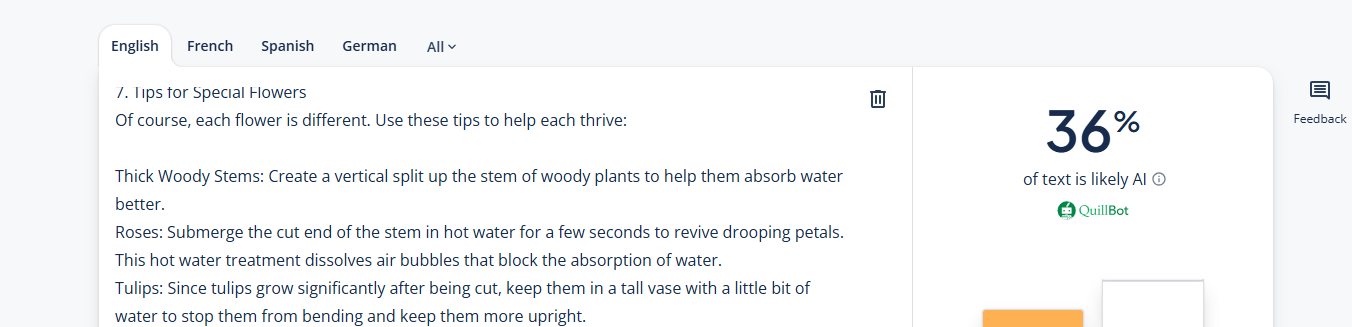
QuillBot: 36% of Text Likely AI

QuillBot free AI detector showed that 36% of text is likely AI on the same human-written article

Figure 2: QuillBot AI Detection Results for the Same Human-Written SEO Blog Article.

When Anna ran the exact same article through QuillBot's AI detector, it flagged 36% of the text as likely AI-generated. This result was quite different from GPTZero. It identified AI writing patterns in content we knew had been written by a human.

Grammarly: 14% Patterns Resembling AI

Grammarly result showing 14% of text has patterns that resemble AI text.

Figure 3: Grammarly AI Detection Results for the Same Article.

According to Grammarly, 14% of the text had patterns that resemble AI text. It explained further below, "These patterns may show AI text or occur in your writing."

While Grammarly returned a lower percentage than QuillBot, it still detected AI-like patterns in an article we knew very well was human-written. The last disclaimer from Grammarly also highlights an important point - that the detected patterns are not necessarily proof of AI use.

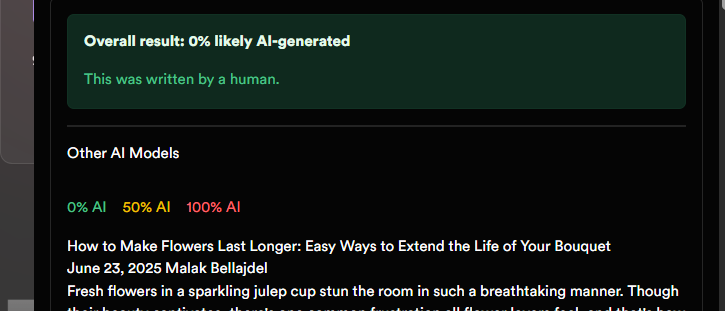
AIDetector: 0% Likely AI Generated

AI detector result reading "Overall result: 0% likely AI-generated. This was written by a human."

Figure 4: AIDetector's Results.

AIDetector returned, "0% likely AI-generated", with the verdict, "This was written by a human." Just like GPTZero, this AI detector correctly identified our article as human-written.

Next, Anna tested two different sections of the same article: the first half and the second.

One AI Detector Scored Two Halves of One Article Differently

Most free AI Detectors have a limit on the number of words you can scan. QuillBot, for instance, has a 1200-word limit per scan. So if you're using a free tool like QuillBot, you might check your article in sections.

We found that the same article can receive very different AI detection scores.

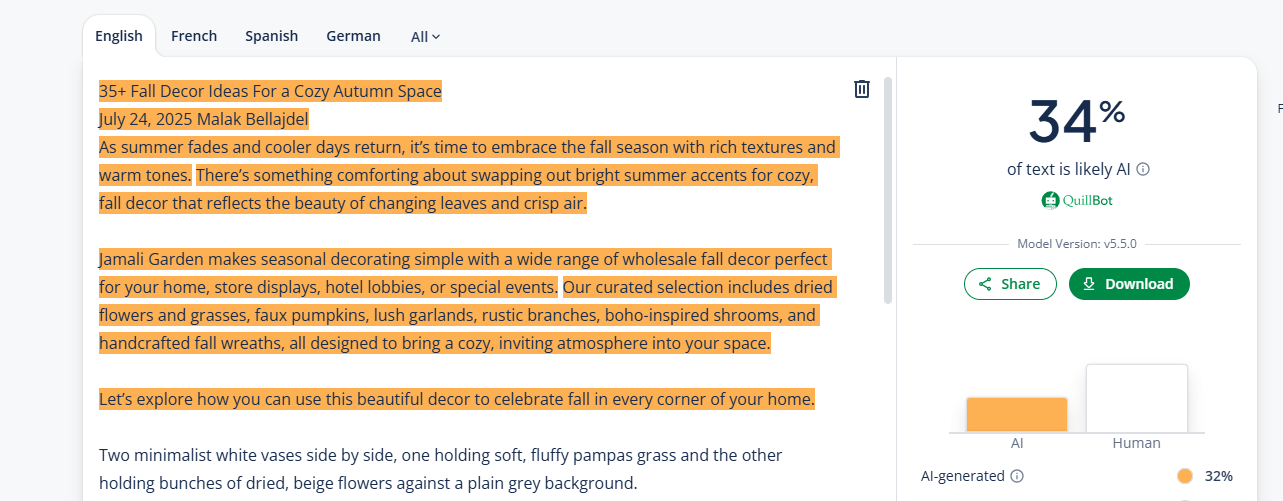
QuillBot result showing 34% of text is likely AI for the first half of the article.

Figure 5: QuillBot AI Detection Results for One Half of the Article

The first half of that article came back as 34% AI, while the second part below returned at 58% AI.

QuillBot result showing 58% of text is likely AI for the second half of the same article.

Figure 6: QuillBot AI Detection Results for the Second Half

This doesn't mean that QuillBot was inconsistent. It was analyzing two different sections, and while written by the same writer, they may have contained different writing patterns. However, this does show you why you should be careful about judging an entire article using the AI score from one section.

Testing Articles Published Years Before ChatGPT Existed

So far, Anna's tests had shown that different AI detection tools could return a spread of scores. However, that alone wasn't telling us how accurate they were.

To investigate further, Anna decided to test articles published years before ChatGPT launched in November 2022. She used the Wayback Machine to find archived blog posts and magazine articles from 2015 and 2016. These older articles gave her a useful comparison because (1) you could independently verify their publication dates, and (2) these articles couldn't have been written using ChatGPT.

If an AI detector flagged these articles as AI-generated writing, we'd have stronger evidence of false positives (when human content is incorrectly flagged as AI).

Three Blog Posts From 2016, All Scored as Part AI

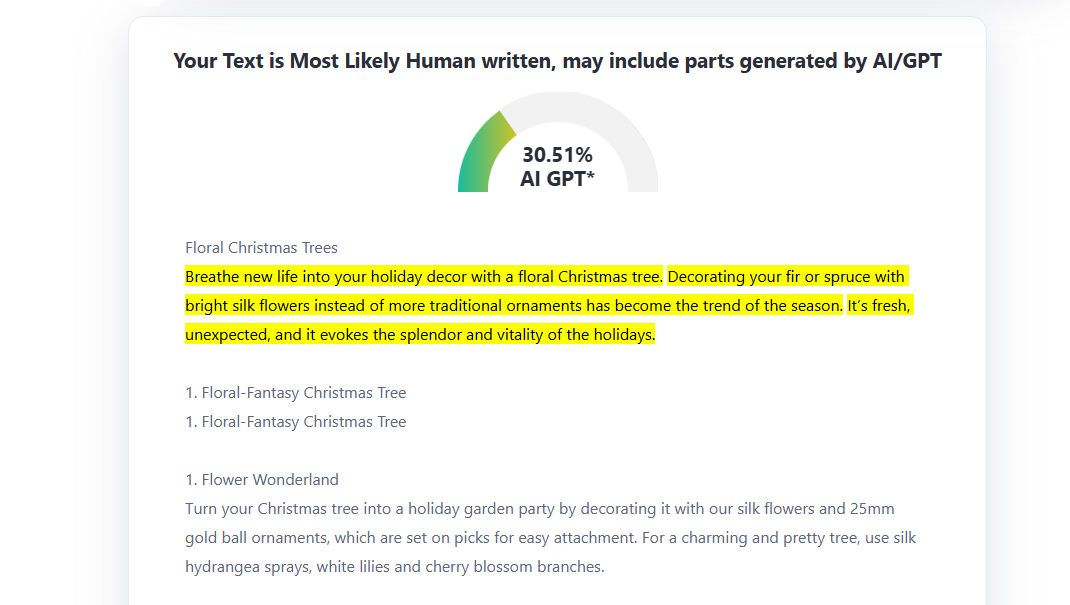
AI detector result showing 30.51% AI GPT for a blog article published in 2016.

Figure 7: ZeroGPT AI Detection Results for a Blog Article Originally Published in 2016.

ZeroGPT, another AI detector, flagged 30.51% of the text as AI-generated.

Anna also tested two more articles from the same 2016 archive. One scored 20.21% AI, while the other scored 25.68%.

A 2015 Magazine Article Was Flagged as 71% AI

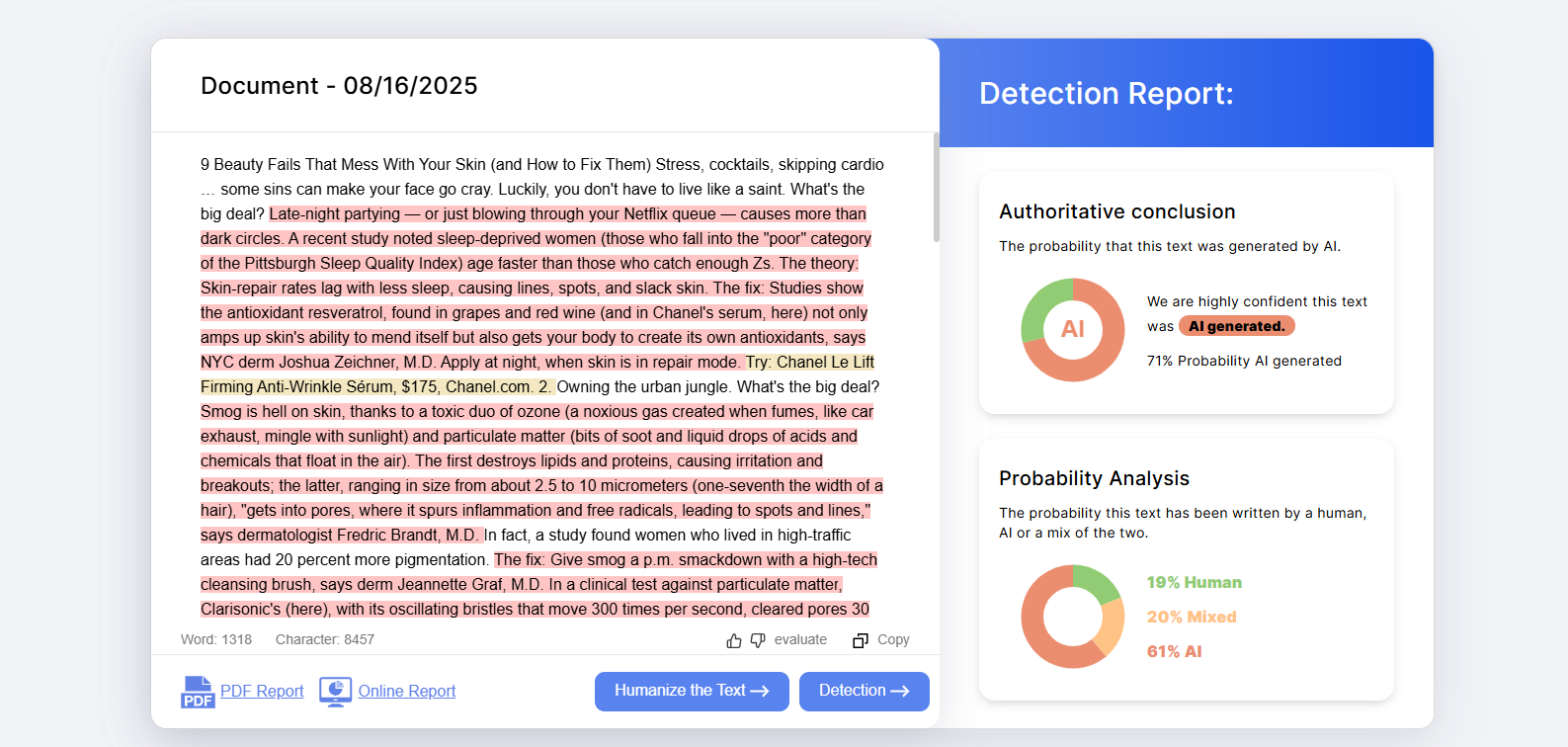
Detection report on a magazine article published in 2015, reading "We are highly confident this text was AI generated," 71% probability AI generated, with a breakdown of 19% Human, 20% Mixed and 61% AI.

Figure 8: Decopy AI Detection Results for a Magazine Article Originally Published in 2015.

Anna also tested a beauty article published by a national magazine in 2015. She retrieved it from a web archive, so we could verify that the content had been published years before ChatGPT launched.

Decopy AI returned a 71% probability that the article was AI-generated, with a breakdown of 61% AI, 20% mixed, and 19% human. It even stated, "We are highly confident this text was AI generated."

This is one of the clearest examples of a false positive in the tests Anna did. The article had been published seven years before ChatGPT launched, but the AI content detector confidently flagged it as AI-generated.

This shows why even a high AI score shouldn't be treated as definitive proof of how content was written.

A 2025 Magazine Article Flagged at 60.03%

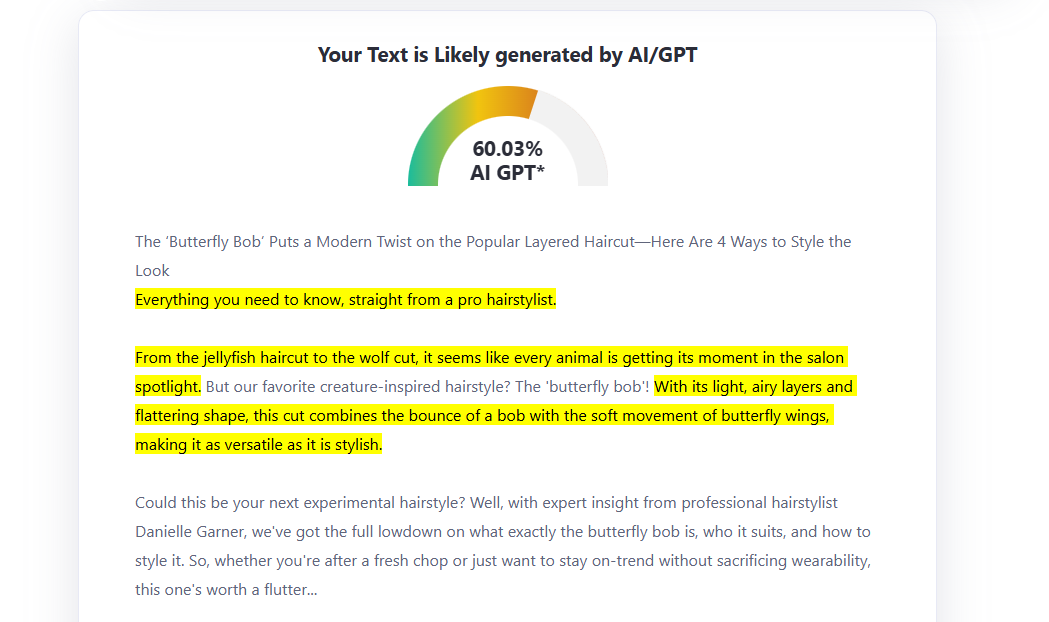
AI detector result showing 60.03% AI GPT and the verdict "Your Text is Likely generated by AI/GPT" for a magazine article published in 2025.

Figure 9: ZeroGPT AI Detection Results for a Magazine Article Originally Published in 2025.

Anna then tested two more current articles from major consumer magazines, both published under named bylines. One piece came back at 60.03% AI, with the verdict "Your Text is Likely generated by AI/GPT", while another scored 36.45% AI.

Compared to the 2015 and 2016 articles, we can't confirm exactly how these articles were written or whether AI tools were used during the writing process. So we can't call these results false positives. However, this shows that even professionally published content can receive relatively high AI detection scores.

In our case, we knew the article had been written by a human, so the percentages flagged as AI-generated by QuillBot and Grammarly were false positives.

Imagine that you often personally write and edit your own articles. Even when a tool flags part of your text as AI, you'll still be confident that your text is human-written.

That's why it's important to understand how content you order from a freelancer or agency is produced. This will help you recognize when you're getting false positives.

So, How Do AI Checkers Work?

Let's try to understand why Anna got the results she did. Why do different AI detectors give different results?

For starters, each tool has its own algorithms, training data, and methods for deciding whether text is AI-generated or human-written. For instance:

  • GPTZero uses a deep learning model trained on millions of human-written texts and AI documents. It analyzes text at the document and sentence level.
  • Copyleaks uses machine learning and linguistic analysis to identify patterns that differ from human writing.
  • Originality.ai uses a custom AI detection model and analyzes entire documents, highlighting individual sentences that may be AI-generated.
  • Grammarly is designed to reduce false positives. It breaks text into smaller sections and analyzes language patterns.
  • ZeroGPT uses its DeepAnalyse™ technology to examine text at multiple levels, including whole-document, sentence, and smaller text segments. It reportedly draws on training data from more than 35 AI model families.

These tools will use different thresholds when detecting AI-writing patterns in text. One detector might consider a particular pattern suspicious, while another won't.

But what exactly are these AI patterns, and how do AI checkers recognize them?

1. Perplexity: How Predictable Is Your Next Word?

Perplexity measures how predictable a piece of text is to a large language model (LLM) (a linguistic model trained with artificial intelligence). That is, it looks at how likely the model is to predict the words you've used.

  • AI-generated writing has low perplexity because LLMs tend to produce words and phrases that fit common language patterns.
  • Human-created text has higher perplexity because writers may use more unexpected words and combinations of phrases.

Detection methods, therefore, identify low randomness in word choice.

For example, "The cat sat on the mat" is a familiar phrase, and most of the words are easy to predict. This gives low perplexity. On the other hand, "The cat abandoned its usual spot and curled up inside an empty flowerpot" is less predictable. A language model may assign it higher perplexity.

Interestingly, human writing can also be quite predictable, especially when explaining something. Think of a blog on Vitamin C supplements. A writer might say, "Vitamin C supports the immune system and helps the body absorb iron." This sentence is clear, factual, and there's nothing unusual about it. However, its wording is very predictable, and it may resemble patterns that an AI detector will flag.

2. Burstiness: How Much Your Sentences Vary

Burstiness is the next pattern AI detectors look for. This refers to how much the predictability and structure of writing vary throughout a piece. The length of sentences is one way to illustrate that variation.

Consider these sentences:

  • Water your plants regularly. Check the soil before watering. Remove any dead leaves. Keep your plants away from cold drafts.

Notice how similar the sentences sound? They're all short and direct, and they follow a certain pattern.

Now compare them with:

  • Water your plants regularly, but always check the soil first. If it still feels damp, leave it for another day. There's no need to overwater.

The second example has more variation in the length of sentences and their structure.

Human writing often has this kind of variation, while some AI-generated writing follows more uniform patterns. That's why AI detectors have always used low burstiness as a possible sign of AI writing.

However, just like perplexity, you'll find some content with low burstiness, yet it's human-written text.

Both Measures Describe Writing Patterns, Not How the Content Was Produced

Perplexity and burstiness help to explain why some human-written content gets flagged as AI-generated. However, modern AI detection tools are more sophisticated; some follow more than these two measures. They use deep learning classifiers trained on human-written text and AI-generated content. These systems look for groups of patterns, and some even highlight text at the sentence level.

Important Takeaway: AI detection scores are not proof of how an article was written. They reflect the assessment of a tool based on patterns it has learned to recognize. That's why we recommend understanding the actual writing process. Don't rely on an AI checker alone, and don't chase 0% AI scores. However, be cautious if you work with an agency and your content has an AI score of 100%. That’s worth investigating.

What About Watermarks? Do AI Models Leave Behind a "Mark"?

Many AI models can leave a hidden "signal" in the text as they generate it.

Watermarks on AI text aren't visible. You can't see them in the document; they're not hidden characters, metadata, or some random extra words. Instead, AI creates a statistical pattern through the words it chooses.

  • For instance: "The man was tall and..." could end in different ways. The AI model might choose "handsome, muscular, well-dressed, etc." All of these words can make sense.

So, a watermarking system will subtly influence the choice of words like these to create a recognizable pattern in the text. Of course, the final writing will still read normally; only that the choice of words and how they are arranged follow a certain statistical pattern.

A compatible detector can look for that hidden pattern using a special key.

Note: The watermark is part of the writing itself. A simple copy and paste will not remove it.

Which AI Models Use Text Watermarking?

  • Google Gemini: In October 2024, Dathathri and colleagues published research on SynthID-Text in Nature. Developed by Google DeepMind, the technology uses a method called tournament sampling to embed watermarks during text generation.
  • Anthropic Claude: In August 2026, Anthropic announced that new Claude models will use a version of SynthID-Text. The company is introducing watermarking across its products and regions. Older models are being brought into the system slowly.
  • Other AI models: Watermarking is different for every company. Different AI providers use different methods, and not every AI-generated document contains a detectable text watermark.

One reason companies are adopting this technology is the EU AI Act. Since August 2, 2026, Article 50 has required AI providers covered by the law to make generated content identifiable through machine-readable marking, subject to applicable provisions and transitional arrangements.

Can AI Watermarks Reliably Identify AI-Generated Content?

Watermarks can provide stronger evidence that a particular AI model was involved in producing text because the signal is added during generation.

However, there are still several limitations:

  1. Not every AI model uses watermarks
  2. Editing can weaken the signal
  3. Short pieces of text are harder to check
  4. AI-assisted editing complicates things

Expert Insight: AI text watermarks could make it easier to identify content generated by certain AI models, but for businesses paying for original, human-written content, the writing process is important.

Why Good Human Writing Gets Flagged as AI

Other tests have also found false positives from AI detectors. This is because:

  • Predictable Choices of Words Flag as AI-Written: Liang et al. (2023) from Stanford scanned 91 TOEFL essays by non-native English speakers, and 88 US eighth-grade essays through 7 popular detectors. The detectors worked well on the eighth-grade essays, but on the TOEFL essays, the average false positive rate was 61.22%. 89 of the 91 were flagged by at least one tool. The essays from the non-native English speakers have lower perplexity than the rest due to simpler and more predictable choices of words, which resembled AI patterns of writing.
  • Difficulty Identifying Mixed Content: Turnitin has reported a false positive rate below 1% at the document level under specific conditions, compared with around 4% at the sentence level. It also acknowledges challenges when analyzing content that mixes human and AI-generated writing.
  • Consistent Brand Voice: Our writers follow each client's brand guidelines to maintain a consistent tone. When Anna tested the client's existing website copy, some of the same phrases flagged in our articles were flagged there too. This suggests that consistent wording may contribute to false positives.

Even OpenAI has struggled with AI detection. In January 2023, the company behind ChatGPT launched its own AI Text Classifier. During testing, it correctly identified just 26% of AI-generated writing and incorrectly flagged 9% of human-written text as AI-generated.

OpenAI discontinued its ChatGPT detector in July 2023, citing low accuracy. The company also warned that its classifier shouldn't be used as the primary basis for determining whether content was AI-generated.

A separate 2023 evaluation tested 12 AI detection tools, including Turnitin and PlagiarismCheck. This evaluation by Weber-Wulff et al. concluded that the available tools are "neither accurate nor reliable".

Important Takeaway: Clear, consistent writing can sometimes resemble content generated by AI. That's why you should review any score you receive along with the writing process.

So What Is the Best AI Checker to Use?

Pick one near-accurate AI detector and stick with it. Using different checkers will produce a lot of noise that you'll have to interpret. Note that many of the free AI detectors have a limit on the number of words you can scan.

If a section returns a high AI score, look it over and review it, and resist AI-humanizing. The passages that score the worst probably have both low perplexity and burstiness, and they need more information and substance. Don't simply reshuffle words.

Here's more on creating valuable articles: SEO blog content for e-commerce

How to Read a Score Without Overreacting: Our Editorial Checklist

  1. Pick one good tool and stay with it. It'll consistently tell you what your own content normally scores.
  2. Don't act on anything under roughly 40%. Every genuine human article we tested landed in that range on at least one tool, and so did the articles we tested that were written before AI even existed.
  3. For any score above 40%, reread and look for writing that's vague or thin.
  4. Treat 100% AI as a red flag. A piece scoring at or near 100 is almost always raw, unedited AI content. Checkers flag human writing in parts.
  5. Don't chase 0%. Our human-written text scored 0% on one detector and 36% in another.
  6. Read what the AI detector returns to understand its verdict.

Important Takeaways: Sometimes when you try to edit and bring the score down, writing may become choppier or vaguer. Don't trade readability for a lower AI score. This may interfere with the user experience and make it difficult for your audience to connect with you.

What Google Says About AI-Generated Content

Google recently addressed this, and we've covered their response in detail in our guide on AI-generated content and SEO.

What Google frowns upon is scaled content abuse, which happens when you generate a lot of content primarily to manipulate search rankings and not help readers. For instance, when you use one prompt to generate hundreds of articles, these articles won't be any different from what's already online. When you post hundreds of these articles on your site every month, you're adding no real value to readers, as there are probably hundreds of similar articles elsewhere. That's scaled content abuse.

The emphasis is on using generative AI to create hundreds of unhelpful articles.

Google isn't focused on AI detection; instead, it judges whether your content is designed to help someone or manipulate rankings. Does it carry real expertise? And a lot of generated text mostly doesn't, which is why so much of it goes unranked.

So, the AI score and ranking in Google are two different issues.

Why We Recommend Human-Written Content

Our findings show why an AI detection score shouldn't be the only way to judge how an article was written. We recommend investing in original, human-written content backed by research, expertise, and thorough editing. An article or page should offer information that's accurate, useful insights, evidence where necessary, and something readers can't find in dozens of similar blog posts.

How We Put This Into Practice at DTC SEO Agency

The articles Anna tested took our writers an average of five to six hours each to research, write, and edit. Our content creation process involves:

  • Research: We use relevant, reliable sources to understand the topic and verify important claims.
  • Experienced Writers: Our writers develop content around the client's industry, audience, and brand guidelines.
  • Editorial Review: Our editors fact-check the content, improve clarity, and make sure it matches the client's voice.
  • AI as a Supporting Tool: We may use AI to organize research or handle repetitive tasks, but we don't rely on it to write the articles.

We bring this same attention to detail to every project we work on. You can see how our approach has helped businesses achieve results in our case studies.

We also believe this approach matters for businesses that want their sites to appear in AI search. Our guide to generative engine optimization explains this in more detail.

FAQs

Can an AI Checker Really Tell If Something Was Written by AI?

It can't tell with certainty. AI checkers analyze writing patterns associated with human-written and AI-generated text; however, they can't verify how an article was produced. As the tests done by Anna show, even human-written content can give you false positives. This is why you should treat any AI score you receive as a signal to investigate, not definitive proof of AI use.

What Is the Most Accurate AI Detector in 2026?

Most tools claim the title at once, which means some of those claims are wrong. Jabarian and Imas (2025), in a University of Chicago working paper, tested four detectors (Pangram, Originality.ai, GPTZero, and the open-source RoBERTa) against a large collection of human and AI-generated text. These researchers found Pangram to be the most reliable AI detector, as per their study's constraints. It rarely flagged human writing as AI-generated (false positives) or missed content that AI had written (false negatives). It was also the only AI detector that kept its false positive rate at or below 0.5% while still accurately detecting AI content.

So, does that make Pangram the most accurate AI checker? Based on this study, it was the strongest performer. But the results don't mean it will get every article right. In our case, for instance, GPTZero was the most accurate.

Does Google Penalize AI Content?

No, Google doesn't penalize content simply because AI was used to write it. Its spam policies target content produced at scale primarily to manipulate search rankings rather than help readers, regardless of whether a human or AI generated it.

What matters is whether the content is accurate, original, and genuinely useful. We still recommend human-written content because experienced writers can bring research, expertise, and original insights to an article that AI-generated writing may lack.

Why Does My Human-Written Content Get Flagged as AI?

AI detectors look for patterns associated with AI-generated writing, such as predictable word choices and consistent sentence structures. The problem is that human writing can have these characteristics too.

For example, a writer following strict brand guidelines might use similar wording throughout an article. An AI checker could flag those patterns even when the content was written entirely by a human. This is called a false positive.

What AI Score Is Acceptable for a Blog Post?

There's no universal acceptable AI score. Every AI detection tool uses its own scoring system, so a 30% score from one checker doesn't necessarily mean the same thing as 30% from another.

Our recommendation is to investigate high scores rather than automatically reject the content. Review the flagged passages, check the writing history, and consider how the article was produced before making a decision.

Can You Get an AI Score Down to Zero?

Yes, it's possible to get a 0% AI detection score, but that doesn't prove your content is human-written.

In Anna's tests, one human-written article received a 0% AI score from one detector, while QuillBot flagged 36% of the same text as likely AI-generated. That's why we don't recommend rewriting perfectly good content just to reach zero. Focus on accuracy, readability, and originality instead of trying to satisfy an AI checker.

References

  • Anthropic. (2026, August 14). How Claude's text watermark works.
  • Dathathri, S., Kohli, P., et al. (2024). Scalable watermarking for identifying large language model outputs. Nature, 634, 818-823.
  • European Commission. (n.d.). Transparency obligations under Article 50 of the AI Act. Shaping Europe's Digital Future.
  • Google. (2026). Spam policies for Google web search. Google Search Central.
  • Jabarian, B., & Imas, A. (2025). Artificial writing and automated detection. Becker Friedman Institute for Economics Working Paper No. 2025-116, University of Chicago.
  • Liang, W., Yuksekgonul, M., Mao, Y., Wu, E., & Zou, J. (2023). GPT detectors are biased against non-native English writers. Patterns, 4(7), 100779.
  • OpenAI. (2023). New AI classifier for indicating AI-written text. OpenAI.
  • Turnitin. (2023). Understanding the false positive rate for sentences of our AI writing detection capability. Turnitin Blog.
  • Weber-Wulff, D., Anohina-Naumeca, A., Bjelobaba, S., Foltýnek, T., Guerrero-Dib, J., Popoola, O., Šigut, P., & Waddington, L. (2023). Testing of detection tools for AI-generated text. International Journal for Educational Integrity, 19, 26.

So, How Accurate Is the "Most Accurate AI Detector"?

Some detectors perform exceptionally well in independent tests, but none can guarantee that every result is correct.

Anna's investigation showed us just how differently AI detection tools can evaluate human-written content. Four checkers gave the same article different scores, two halves of another article received results 24 percentage points apart, and articles published years before ChatGPT launched were flagged as AI-generated.

Does that mean AI checkers are useless? Not at all. They can help identify writing that may need a closer look. But even a high AI score shouldn't replace evidence of how the content was actually produced.

Our recommendation is simple: use AI detection tools as part of your review process, not as the final judge of whether something was written by a human.

And when it comes to creating content, our standards remain the same. We believe in original, well-researched articles written by people who understand the subject. AI can support parts of that process, but it shouldn't replace the expertise that makes content valuable to readers.

If you're looking to build a content library that provides real value and supports your SEO goals, book a call to discuss how we can help.

See How We Can Help
Your Brand Grow

What Is the Most Accurate AI Checker? We Tested Four Tools on the Same Article

Written by

Thomas Phillips

Building SEO Since 13 years Old. I didn’t set out to build an agency — I set out to solve a problem.

In this story

A client asked us a fair question this fall. They ran three blog articles we had written for them through an AI checker, and the numbers worried them. Our lead editor, Anna Ryan, spent a weekend looking into it. She tested those articles on every AI detection tool she could get access to, and, for comparison, also tested archived articles published years before ChatGPT launched. She was trying to see which AI detector was the most accurate.

What she noticed was quite interesting. Here are her findings, what they reveal about the accuracy of AI detectors, and how we would recommend using AI detection tools when reviewing your content.

Key Takeaways

  • Different AI detectors give different scores.
  • The AI score you see is a probability, and one at or near 100% is worth investigating.
  • You might get false positives sometimes; even human-written text can return a high score.
  • Don't chase a 0% AI score. No detector is completely accurate, and using multiple tools doesn't necessarily provide a more reliable answer.
  • We recommend unique, highly valuable human-written content supported by thorough research, fact-checking, and editing. AI can help with parts of the writing process; it shouldn't replace the writer's expertise.

Many of the detectors we've come across (Originality.ai, Copyleaks, Winston AI, GPTZero, ZeroGPT, Pangram, and more) position themselves as the most accurate. Other tools like Grammarly's AI checker claim 99.9% accuracy. Could all these checkers be right in their claims?

What Four AI Detection Tools Said About One Human-Written Article

For the test, Anna took blog articles our team had written by hand as part of our SEO content creation work for an e-commerce brand. Each of these articles had taken an average of five to six hours of research and editing, so we knew exactly how the content had been produced.

Anna wanted to answer three questions: (1) Would different AI checkers give the same article similar scores? (2) Could AI detectors identify human-written content reliably? and (3) How much can you trust the results of an AI checker?

She tested the articles using GPTZero, QuillBot, Grammarly, and AIDetector.

*The client is anonymized here at their request, and the results below are unedited.

GPTZero: 98% Human-Written Text

GPTZero result showing 1% AI generated, 1% Mixed and 98% Human, with the verdict "We are highly confident this text is entirely human"

Figure 1: GPTZero AI Detection Test Results

GPTZero returned 98% human, 1% AI-generated content, and 1% mixed, noting, "We are highly confident this text is entirely human."

GPTZero correctly identified our article as human-written. Would the other tools reach the same conclusion?

QuillBot: 36% of Text Likely AI
QuillBot free AI detector showed that 36% of text is likely AI on the same human-written article

Figure 2: QuillBot AI Detection Results for the Same Human-Written SEO Blog Article.

When Anna ran the exact same article through QuillBot's AI detector, it flagged 36% of the text as likely AI-generated. This result was quite different from GPTZero. It identified AI writing patterns in content we knew had been written by a human.

Grammarly: 14% Patterns Resembling AI

Grammarly result showing 14% of text has patterns that resemble AI text.

Figure 3: Grammarly AI Detection Results for the Same Article.

According to Grammarly, 14% of the text had patterns that resemble AI text. It explained further below, "These patterns may show AI text or occur in your writing."

While Grammarly returned a lower percentage than QuillBot, it still detected AI-like patterns in an article we knew very well was human-written. The last disclaimer from Grammarly also highlights an important point - that the detected patterns are not necessarily proof of AI use.

AIDetector: 0% Likely AI Generated
AI detector result reading "Overall result: 0% likely AI-generated. This was written by a human."

Figure 4: AIDetector's Results.

AIDetector returned, "0% likely AI-generated", with the verdict, "This was written by a human." Just like GPTZero, this AI detector correctly identified our article as human-written.

Next, Anna tested two different sections of the same article: the first half and the second.

One AI Detector Scored Two Halves of One Article Differently

Most free AI Detectors have a limit on the number of words you can scan. QuillBot, for instance, has a 1200-word limit per scan. So if you're using a free tool like QuillBot, you might check your article in sections.

We found that the same article can receive very different AI detection scores.
QuillBot result showing 34% of text is likely AI for the first half of the article.

Figure 5: QuillBot AI Detection Results for One Half of the Article

The first half of that article came back as 34% AI, while the second part below returned at 58% AI.

QuillBot result showing 58% of text is likely AI for the second half of the same article.

Figure 6: QuillBot AI Detection Results for the Second Half

This doesn't mean that QuillBot was inconsistent. It was analyzing two different sections, and while written by the same writer, they may have contained different writing patterns. However, this does show you why you should be careful about judging an entire article using the AI score from one section.

Testing Articles Published Years Before ChatGPT Existed

So far, Anna's tests had shown that different AI detection tools could return a spread of scores. However, that alone wasn't telling us how accurate they were.

To investigate further, Anna decided to test articles published years before ChatGPT launched in November 2022. She used the Wayback Machine to find archived blog posts and magazine articles from 2015 and 2016. These older articles gave her a useful comparison because (1) you could independently verify their publication dates, and (2) these articles couldn't have been written using ChatGPT.

If an AI detector flagged these articles as AI-generated writing, we'd have stronger evidence of false positives (when human content is incorrectly flagged as AI).

Three Blog Posts From 2016, All Scored as Part AI
AI detector result showing 30.51% AI GPT for a blog article published in 2016.

Figure 7: ZeroGPT AI Detection Results for a Blog Article Originally Published in 2016.

ZeroGPT, another AI detector, flagged 30.51% of the text as AI-generated.

Anna also tested two more articles from the same 2016 archive. One scored 20.21% AI, while the other scored 25.68%.

A 2015 Magazine Article Was Flagged as 71% AI
Detection report on a magazine article published in 2015, reading "We are highly confident this text was AI generated," 71% probability AI generated, with a breakdown of 19% Human, 20% Mixed and 61% AI.

Figure 8: Decopy AI Detection Results for a Magazine Article Originally Published in 2015.

Anna also tested a beauty article published by a national magazine in 2015. She retrieved it from a web archive, so we could verify that the content had been published years before ChatGPT launched.

Decopy AI returned a 71% probability that the article was AI-generated, with a breakdown of 61% AI, 20% mixed, and 19% human. It even stated, "We are highly confident this text was AI generated."

This is one of the clearest examples of a false positive in the tests Anna did. The article had been published seven years before ChatGPT launched, but the AI content detector confidently flagged it as AI-generated.

This shows why even a high AI score shouldn't be treated as definitive proof of how content was written.

A 2025 Magazine Article Flagged at 60.03%
AI detector result showing 60.03% AI GPT and the verdict "Your Text is Likely generated by AI/GPT" for a magazine article published in 2025.

Figure 9: ZeroGPT AI Detection Results for a Magazine Article Originally Published in 2025.

Anna then tested two more current articles from major consumer magazines, both published under named bylines. One piece came back at 60.03% AI, with the verdict "Your Text is Likely generated by AI/GPT", while another scored 36.45% AI.

Compared to the 2015 and 2016 articles, we can't confirm exactly how these articles were written or whether AI tools were used during the writing process. So we can't call these results false positives. However, this shows that even professionally published content can receive relatively high AI detection scores.

In our case, we knew the article had been written by a human, so the percentages flagged as AI-generated by QuillBot and Grammarly were false positives.

Imagine that you often personally write and edit your own articles. Even when a tool flags part of your text as AI, you'll still be confident that your text is human-written.

That's why it's important to understand how content you order from a freelancer or agency is produced. This will help you recognize when you're getting false positives.

So, How Do AI Checkers Work?

Let's try to understand why Anna got the results she did. Why do different AI detectors give different results?

For starters, each tool has its own algorithms, training data, and methods for deciding whether text is AI-generated or human-written. For instance:

  • GPTZero uses a deep learning model trained on millions of human-written texts and AI documents. It analyzes text at the document and sentence level.
  • Copyleaks uses machine learning and linguistic analysis to identify patterns that differ from human writing.
  • Originality.ai uses a custom AI detection model and analyzes entire documents, highlighting individual sentences that may be AI-generated.
  • Grammarly is designed to reduce false positives. It breaks text into smaller sections and analyzes language patterns.
  • ZeroGPT uses its DeepAnalyse™ technology to examine text at multiple levels, including whole-document, sentence, and smaller text segments. It reportedly draws on training data from more than 35 AI model families.

These tools will use different thresholds when detecting AI-writing patterns in text. One detector might consider a particular pattern suspicious, while another won't.

But what exactly are these AI patterns, and how do AI checkers recognize them?

1. Perplexity: How Predictable Is Your Next Word?

Perplexity measures how predictable a piece of text is to a large language model (LLM) (a linguistic model trained with artificial intelligence). That is, it looks at how likely the model is to predict the words you've used.

  • AI-generated writing has low perplexity because LLMs tend to produce words and phrases that fit common language patterns.
  • Human-created text has higher perplexity because writers may use more unexpected words and combinations of phrases.

Detection methods, therefore, identify low randomness in word choice.

For example, "The cat sat on the mat" is a familiar phrase, and most of the words are easy to predict. This gives low perplexity. On the other hand, "The cat abandoned its usual spot and curled up inside an empty flowerpot" is less predictable. A language model may assign it higher perplexity.

Interestingly, human writing can also be quite predictable, especially when explaining something. Think of a blog on Vitamin C supplements. A writer might say, "Vitamin C supports the immune system and helps the body absorb iron." This sentence is clear, factual, and there's nothing unusual about it. However, its wording is very predictable, and it may resemble patterns that an AI detector will flag.

2. Burstiness: How Much Your Sentences Vary

Burstiness is the next pattern AI detectors look for. This refers to how much the predictability and structure of writing vary throughout a piece. The length of sentences is one way to illustrate that variation.

Consider these sentences:

  • Water your plants regularly. Check the soil before watering. Remove any dead leaves. Keep your plants away from cold drafts.

Notice how similar the sentences sound? They're all short and direct, and they follow a certain pattern.

Now compare them with:

  • Water your plants regularly, but always check the soil first. If it still feels damp, leave it for another day. There's no need to overwater.

The second example has more variation in the length of sentences and their structure.

Human writing often has this kind of variation, while some AI-generated writing follows more uniform patterns. That's why AI detectors have always used low burstiness as a possible sign of AI writing.

However, just like perplexity, you'll find some content with low burstiness, yet it's human-written text.

Both Measures Describe Writing Patterns, Not How the Content Was Produced

Perplexity and burstiness help to explain why some human-written content gets flagged as AI-generated. However, modern AI detection tools are more sophisticated; some follow more than these two measures. They use deep learning classifiers trained on human-written text and AI-generated content. These systems look for groups of patterns, and some even highlight text at the sentence level.

Important Takeaway: AI detection scores are not proof of how an article was written. They reflect the assessment of a tool based on patterns it has learned to recognize. That's why we recommend understanding the actual writing process. Don't rely on an AI checker alone, and don't chase 0% AI scores. However, be cautious if you work with an agency and your content has an AI score of 100%. That’s worth investigating.

What About Watermarks? Do AI Models Leave Behind a "Mark"?

Many AI models can leave a hidden "signal" in the text as they generate it.

Watermarks on AI text aren't visible. You can't see them in the document; they're not hidden characters, metadata, or some random extra words. Instead, AI creates a statistical pattern through the words it chooses.

  • For instance: "The man was tall and..." could end in different ways. The AI model might choose "handsome, muscular, well-dressed, etc." All of these words can make sense.

So, a watermarking system will subtly influence the choice of words like these to create a recognizable pattern in the text. Of course, the final writing will still read normally; only that the choice of words and how they are arranged follow a certain statistical pattern.

A compatible detector can look for that hidden pattern using a special key.

Note: The watermark is part of the writing itself. A simple copy and paste will not remove it.

Which AI Models Use Text Watermarking?

  • Google Gemini: In October 2024, Dathathri and colleagues published research on SynthID-Text in Nature. Developed by Google DeepMind, the technology uses a method called tournament sampling to embed watermarks during text generation.
  • Anthropic Claude: In August 2026, Anthropic announced that new Claude models will use a version of SynthID-Text. The company is introducing watermarking across its products and regions. Older models are being brought into the system slowly.
  • Other AI models: Watermarking is different for every company. Different AI providers use different methods, and not every AI-generated document contains a detectable text watermark.

One reason companies are adopting this technology is the EU AI Act. Since August 2, 2026, Article 50 has required AI providers covered by the law to make generated content identifiable through machine-readable marking, subject to applicable provisions and transitional arrangements.

Can AI Watermarks Reliably Identify AI-Generated Content?

Watermarks can provide stronger evidence that a particular AI model was involved in producing text because the signal is added during generation.

However, there are still several limitations:

  1. Not every AI model uses watermarks
  2. Editing can weaken the signal
  3. Short pieces of text are harder to check
  4. AI-assisted editing complicates things

Expert Insight: AI text watermarks could make it easier to identify content generated by certain AI models, but for businesses paying for original, human-written content, the writing process is important.

Why Good Human Writing Gets Flagged as AI

Other tests have also found false positives from AI detectors. This is because:

  • Predictable Choices of Words Flag as AI-Written: Liang et al. (2023) from Stanford scanned 91 TOEFL essays by non-native English speakers, and 88 US eighth-grade essays through 7 popular detectors. The detectors worked well on the eighth-grade essays, but on the TOEFL essays, the average false positive rate was 61.22%. 89 of the 91 were flagged by at least one tool. The essays from the non-native English speakers have lower perplexity than the rest due to simpler and more predictable choices of words, which resembled AI patterns of writing.
  • Difficulty Identifying Mixed Content: Turnitin has reported a false positive rate below 1% at the document level under specific conditions, compared with around 4% at the sentence level. It also acknowledges challenges when analyzing content that mixes human and AI-generated writing.
  • Consistent Brand Voice: Our writers follow each client's brand guidelines to maintain a consistent tone. When Anna tested the client's existing website copy, some of the same phrases flagged in our articles were flagged there too. This suggests that consistent wording may contribute to false positives.

Even OpenAI has struggled with AI detection. In January 2023, the company behind ChatGPT launched its own AI Text Classifier. During testing, it correctly identified just 26% of AI-generated writing and incorrectly flagged 9% of human-written text as AI-generated.

OpenAI discontinued its ChatGPT detector in July 2023, citing low accuracy. The company also warned that its classifier shouldn't be used as the primary basis for determining whether content was AI-generated.

A separate 2023 evaluation tested 12 AI detection tools, including Turnitin and PlagiarismCheck. This evaluation by Weber-Wulff et al. concluded that the available tools are "neither accurate nor reliable".

Important Takeaway: Clear, consistent writing can sometimes resemble content generated by AI. That's why you should review any score you receive along with the writing process.

So What Is the Best AI Checker to Use?

Pick one near-accurate AI detector and stick with it. Using different checkers will produce a lot of noise that you'll have to interpret. Note that many of the free AI detectors have a limit on the number of words you can scan.

If a section returns a high AI score, look it over and review it, and resist AI-humanizing. The passages that score the worst probably have both low perplexity and burstiness, and they need more information and substance. Don't simply reshuffle words.

Here's more on creating valuable articles: SEO blog content for e-commerce

How to Read a Score Without Overreacting: Our Editorial Checklist

  1. Pick one good tool and stay with it. It'll consistently tell you what your own content normally scores.
  2. Don't act on anything under roughly 40%. Every genuine human article we tested landed in that range on at least one tool, and so did the articles we tested that were written before AI even existed.
  3. For any score above 40%, reread and look for writing that's vague or thin.
  4. Treat 100% AI as a red flag. A piece scoring at or near 100 is almost always raw, unedited AI content. Checkers flag human writing in parts.
  5. Don't chase 0%. Our human-written text scored 0% on one detector and 36% in another.
  6. Read what the AI detector returns to understand its verdict.

Important Takeaways: Sometimes when you try to edit and bring the score down, writing may become choppier or vaguer. Don't trade readability for a lower AI score. This may interfere with the user experience and make it difficult for your audience to connect with you.

What Google Says About AI-Generated Content

Google recently addressed this, and we've covered their response in detail in our guide on AI-generated content and SEO.

What Google frowns upon is scaled content abuse, which happens when you generate a lot of content primarily to manipulate search rankings and not help readers. For instance, when you use one prompt to generate hundreds of articles, these articles won't be any different from what's already online. When you post hundreds of these articles on your site every month, you're adding no real value to readers, as there are probably hundreds of similar articles elsewhere. That's scaled content abuse.

The emphasis is on using generative AI to create hundreds of unhelpful articles.

Google isn't focused on AI detection; instead, it judges whether your content is designed to help someone or manipulate rankings. Does it carry real expertise? And a lot of generated text mostly doesn't, which is why so much of it goes unranked.

So, the AI score and ranking in Google are two different issues.

Why We Recommend Human-Written Content

Our findings show why an AI detection score shouldn't be the only way to judge how an article was written. We recommend investing in original, human-written content backed by research, expertise, and thorough editing. An article or page should offer information that's accurate, useful insights, evidence where necessary, and something readers can't find in dozens of similar blog posts.

How We Put This Into Practice at DTC SEO Agency

The articles Anna tested took our writers an average of five to six hours each to research, write, and edit. Our content creation process involves:

  • Research: We use relevant, reliable sources to understand the topic and verify important claims.
  • Experienced Writers: Our writers develop content around the client's industry, audience, and brand guidelines.
  • Editorial Review: Our editors fact-check the content, improve clarity, and make sure it matches the client's voice.
  • AI as a Supporting Tool: We may use AI to organize research or handle repetitive tasks, but we don't rely on it to write the articles.

We bring this same attention to detail to every project we work on. You can see how our approach has helped businesses achieve results in our case studies.

We also believe this approach matters for businesses that want their sites to appear in AI search. Our guide to generative engine optimization explains this in more detail.

FAQs

Can an AI Checker Really Tell If Something Was Written by AI?

It can't tell with certainty. AI checkers analyze writing patterns associated with human-written and AI-generated text; however, they can't verify how an article was produced. As the tests done by Anna show, even human-written content can give you false positives. This is why you should treat any AI score you receive as a signal to investigate, not definitive proof of AI use.

What Is the Most Accurate AI Detector in 2026?

Most tools claim the title at once, which means some of those claims are wrong. Jabarian and Imas (2025), in a University of Chicago working paper, tested four detectors (Pangram, Originality.ai, GPTZero, and the open-source RoBERTa) against a large collection of human and AI-generated text. These researchers found Pangram to be the most reliable AI detector, as per their study's constraints. It rarely flagged human writing as AI-generated (false positives) or missed content that AI had written (false negatives). It was also the only AI detector that kept its false positive rate at or below 0.5% while still accurately detecting AI content.

So, does that make Pangram the most accurate AI checker? Based on this study, it was the strongest performer. But the results don't mean it will get every article right. In our case, for instance, GPTZero was the most accurate.

Does Google Penalize AI Content?

No, Google doesn't penalize content simply because AI was used to write it. Its spam policies target content produced at scale primarily to manipulate search rankings rather than help readers, regardless of whether a human or AI generated it.

What matters is whether the content is accurate, original, and genuinely useful. We still recommend human-written content because experienced writers can bring research, expertise, and original insights to an article that AI-generated writing may lack.

Why Does My Human-Written Content Get Flagged as AI?

AI detectors look for patterns associated with AI-generated writing, such as predictable word choices and consistent sentence structures. The problem is that human writing can have these characteristics too.

For example, a writer following strict brand guidelines might use similar wording throughout an article. An AI checker could flag those patterns even when the content was written entirely by a human. This is called a false positive.

What AI Score Is Acceptable for a Blog Post?

There's no universal acceptable AI score. Every AI detection tool uses its own scoring system, so a 30% score from one checker doesn't necessarily mean the same thing as 30% from another.

Our recommendation is to investigate high scores rather than automatically reject the content. Review the flagged passages, check the writing history, and consider how the article was produced before making a decision.

Can You Get an AI Score Down to Zero?

Yes, it's possible to get a 0% AI detection score, but that doesn't prove your content is human-written.

In Anna's tests, one human-written article received a 0% AI score from one detector, while QuillBot flagged 36% of the same text as likely AI-generated. That's why we don't recommend rewriting perfectly good content just to reach zero. Focus on accuracy, readability, and originality instead of trying to satisfy an AI checker.

References

  • Anthropic. (2026, August 14). How Claude's text watermark works.
  • Dathathri, S., Kohli, P., et al. (2024). Scalable watermarking for identifying large language model outputs. Nature, 634, 818-823.
  • European Commission. (n.d.). Transparency obligations under Article 50 of the AI Act. Shaping Europe's Digital Future.
  • Google. (2026). Spam policies for Google web search. Google Search Central.
  • Jabarian, B., & Imas, A. (2025). Artificial writing and automated detection. Becker Friedman Institute for Economics Working Paper No. 2025-116, University of Chicago.
  • Liang, W., Yuksekgonul, M., Mao, Y., Wu, E., & Zou, J. (2023). GPT detectors are biased against non-native English writers. Patterns, 4(7), 100779.
  • OpenAI. (2023). New AI classifier for indicating AI-written text. OpenAI.
  • Turnitin. (2023). Understanding the false positive rate for sentences of our AI writing detection capability. Turnitin Blog.
  • Weber-Wulff, D., Anohina-Naumeca, A., Bjelobaba, S., Foltýnek, T., Guerrero-Dib, J., Popoola, O., Šigut, P., & Waddington, L. (2023). Testing of detection tools for AI-generated text. International Journal for Educational Integrity, 19, 26.

So, How Accurate Is the "Most Accurate AI Detector"?

Some detectors perform exceptionally well in independent tests, but none can guarantee that every result is correct.

Anna's investigation showed us just how differently AI detection tools can evaluate human-written content. Four checkers gave the same article different scores, two halves of another article received results 24 percentage points apart, and articles published years before ChatGPT launched were flagged as AI-generated.

Does that mean AI checkers are useless? Not at all. They can help identify writing that may need a closer look. But even a high AI score shouldn't replace evidence of how the content was actually produced.

Our recommendation is simple: use AI detection tools as part of your review process, not as the final judge of whether something was written by a human.

And when it comes to creating content, our standards remain the same. We believe in original, well-researched articles written by people who understand the subject. AI can support parts of that process, but it shouldn't replace the expertise that makes content valuable to readers.

If you're looking to build a content library that provides real value and supports your SEO goals, book a call to discuss how we can help.

Ready to stop losing to better-ranked competitors?

One call. We'll map your specialty, your compliance needs, and the fastest path to a lower blended CAC — then hand you a full SEO and AI Search strategy, with pricing.

Book your strategy call →